How to Answer “Tell Me About Yourself” in an Interview: 2026 Guide & Scripts
“Tell me about yourself.”
Stay connected
Add us as a trusted source on Google
Get our latest guides, updates, and helpful resources surfaced more often when you search and browse.
At first glance, it seems like a simple icebreaker. However, it is often the most important question you’ll face during a job interview. Since it is usually asked within the first few minutes, your answer creates the interviewer’s first impression and often shapes the direction of the entire conversation.
A weak response can make you appear unprepared or unfocused. A strong response, on the other hand, positions you as a confident professional whose experience and goals align perfectly with the role.
In this complete 2026 guide, you’ll learn a proven framework for answering this question effectively, common mistakes to avoid, and ready-to-use examples for freshers, developers, and career changers.
1. Why Do Interviewers Ask “Tell Me About Yourself”?
To answer this question successfully, you first need to understand what employers are trying to assess.
Interviewers aren’t asking for your life story, nor do they want you to read your resume back to them. Instead, they’re evaluating three key areas:
Communication Skills
Can you organize your thoughts clearly and present your professional story in a concise, engaging manner?
Professional Identity
Do you understand your strengths, experience, and how they relate to the position you’re applying for?
Confidence and Cultural Fit
Can you communicate confidently under pressure, and does your career path logically connect to the role you’re seeking?
2. The Best Structure: The Present-Past-Future Framework
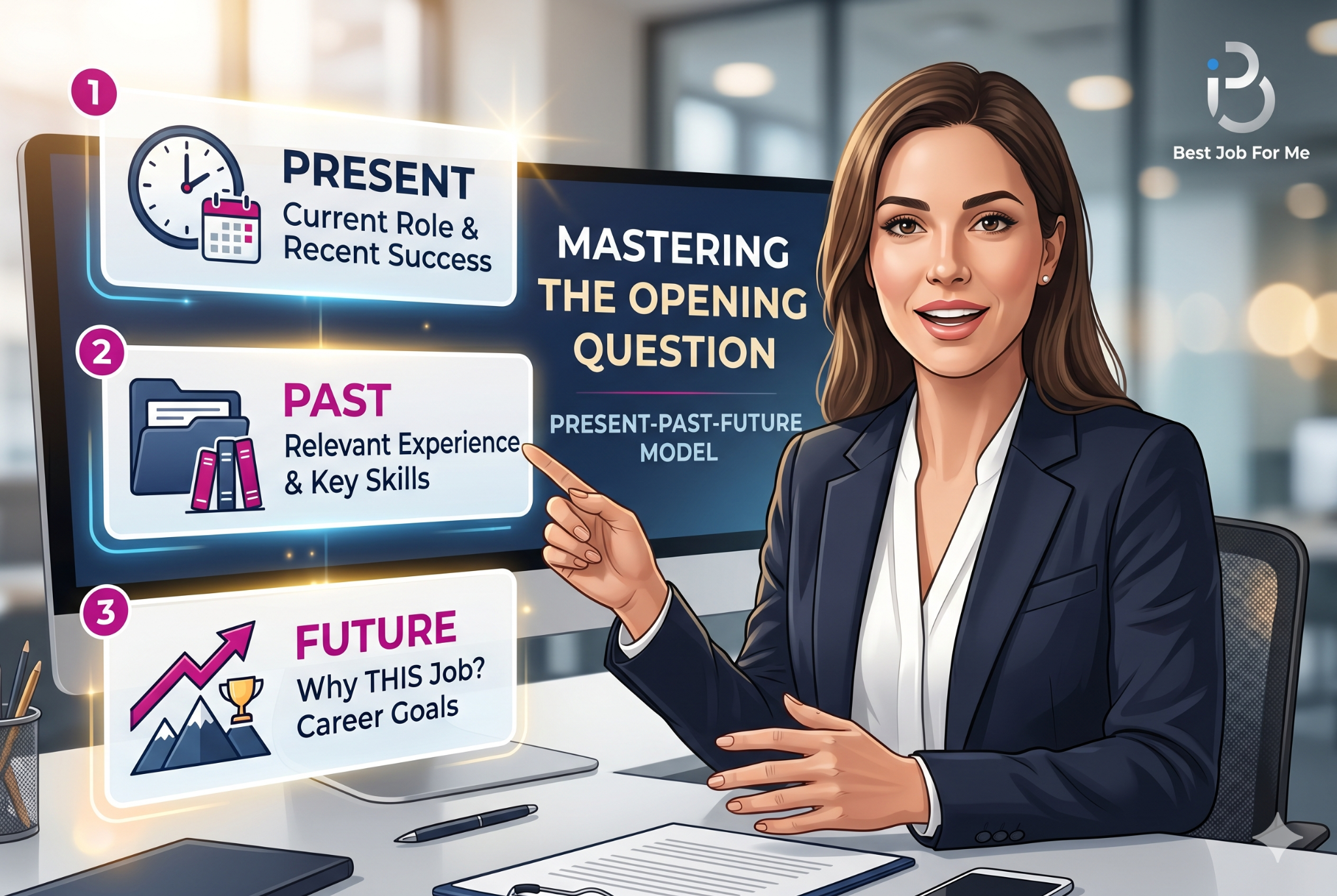
One of the most effective ways to answer this question is by using the Present-Past-Future framework.
This approach helps you stay organized, relevant, and focused while avoiding unnecessary details.
| Section | Focus |
|---|---|
| Present | Your current role, skills, or recent achievements |
| Past | Relevant experience, education, or accomplishments |
| Future | Why you’re interested in this role and company |
Step 1: Start with the Present
Begin by explaining where you are professionally today. Mention your current position, area of expertise, or recent accomplishment.
Example:
“I currently work as a junior web developer, focusing on responsive frontend development. In my most recent project, I helped redesign a client portal, resulting in a 35% improvement in page load performance.”
Step 2: Connect with the Past
Next, briefly explain the experiences that helped you reach your current position. Focus only on details that are relevant to the role.
Example:
“Prior to that, I spent two years building freelance websites for local businesses, where I developed strong skills in HTML, CSS, and PHP. Those projects taught me the importance of writing clean, maintainable code while meeting client requirements.”
Step 3: Finish with the Future
Conclude by explaining why you’re interested in the opportunity and how it fits into your career goals.
Example:
“While I’ve enjoyed freelancing, I’m excited about joining a collaborative team environment where I can contribute to larger projects. I’ve followed your agency’s work for some time, and I’m eager to apply my optimization and development skills within your organization.”
3. Common Mistakes to Avoid
Even qualified candidates can weaken their response by making a few common mistakes.
Turning It Into a Personal Biography
Avoid discussing your family background, hobbies, hometown, or personal interests unless the interviewer specifically asks. Keep your answer focused on your professional journey.
Repeating Your Resume
The interviewer has already reviewed your resume. Instead of listing every position you’ve held, highlight the most relevant experiences and achievements.
Speaking for Too Long
An effective answer should typically last between 60 and 90 seconds. Going beyond that can cause the interviewer to lose interest.
Downplaying Your Achievements
An interview is your opportunity to showcase your value. Be confident when discussing accomplishments and skills that demonstrate your qualifications.
4. Sample Answers You Can Customize
The following examples can serve as templates for different career stages and situations.
Sample Answer for Freshers and Recent Graduates
“I recently completed my degree in Computer Applications, where I developed a strong foundation in web development and database management. As part of my final-year project, I created a complete eCommerce web application, handling everything from database design to frontend development.
Outside of academics, I’ve spent the past several months building personal projects and improving my programming skills. I’m particularly excited about this Associate Developer opportunity because it offers a strong learning environment where I can apply my knowledge while continuing to grow as a professional.”
Sample Answer for Developers and Technical Professionals
“I’m a web developer with a strong focus on content management systems and performance optimization. Over the past few years, I’ve specialized in building custom WordPress themes and plugins while ensuring websites remain fast, scalable, and mobile-friendly.
One of my recent projects involved restructuring a legacy plugin using object-oriented PHP principles, which significantly improved maintainability and reduced server resource usage.
I’m excited about this opportunity because your organization works on large-scale digital platforms, and I’d love to contribute my development and optimization experience to projects with greater complexity and impact.”
Sample Answer for Career Changers
“For the past three years, I’ve worked in customer success, where I regularly helped clients solve software-related challenges and improve their overall experience. Through that role, I became increasingly interested in how software products are designed and developed.
Over time, I completed several frontend development courses and built multiple responsive web projects to strengthen my technical skills.
What makes my background unique is my ability to combine technical knowledge with a strong understanding of user needs. I’m now looking to begin my career as a developer and contribute both my technical abilities and customer-focused perspective.”
Final Thoughts
The key to answering “Tell me about yourself” successfully is preparation.
Rather than improvising during the interview, create a structured response using the Present-Past-Future framework. Practice it until it sounds natural, conversational, and confident, while keeping the total length under 90 seconds.
A strong opening answer helps establish credibility, creates a positive first impression, and sets the stage for a successful interview. By preparing in advance, you’ll be ready to approach the rest of the interview with greater confidence and clarity.