Where Do You See Yourself in 5 Years? Best Interview Answers

When an interviewer asks, “Where do you see yourself in 5 years?”, you may not know exactly what your career will look like five years from now. Fortunately, employers do not expect you to predict the future.
Stay connected
Add us as a trusted source on Google
Get our latest guides, updates, and helpful resources surfaced more often when you search and browse.
What they really want to understand is whether you have realistic career goals, whether the position fits those goals, and whether you are likely to grow with the company.
A strong answer should show ambition without making unrealistic promises. It should also connect your professional development with the opportunity you are interviewing for.
In this guide, you’ll learn how to answer “Where do you see yourself in 5 years?”, what employers want to hear, mistakes to avoid, and sample answers for freshers, experienced professionals, career changers, and other job seekers.
Why Do Interviewers Ask “Where Do You See Yourself in 5 Years?”
Employers ask this question to learn more about your career direction and motivation.
Your answer can help an interviewer determine whether the position matches what you want from your career.
They may be trying to understand:
- Whether you have clear career goals
- How ambitious you are
- Whether you are interested in professional development
- Whether the position fits your long-term plans
- How likely you are to stay with the company
- Whether your expectations are realistic
There is no single perfect five-year plan. The interviewer is usually more interested in the direction you want to take than the exact job title you hope to have.
What Employers Want to Hear
A good answer should connect three things: your goals, the position, and the company.
You Want to Develop Your Skills
Employers generally want people who are willing to learn.
You can talk about improving technical skills, developing leadership abilities, gaining industry knowledge, or taking on additional responsibilities.
For example:
“Over the next five years, I’d like to deepen my expertise in this field and gradually take on more responsibility.”
This demonstrates ambition without making unrealistic claims.
You Are Interested in the Current Position
One of the biggest mistakes candidates make is focusing entirely on a future position.
Remember that you are interviewing for the job available today.
Your answer should make it clear that you are genuinely interested in the current opportunity.
Your Goals Can Grow With the Company
Employers invest time and money in recruiting and training employees. They naturally prefer candidates who may stay and develop within the organization.
You do not need to promise that you will remain with the company for exactly five years.
Instead, demonstrate that the opportunity fits the direction in which you want your career to develop.
How to Answer “Where Do You See Yourself in 5 Years?”
You can create a strong answer using a simple three-step approach.
Step 1: Start With Skills You Want to Develop
Think about the skills that are important in your profession.
You might want to:
- Develop stronger technical expertise
- Improve communication skills
- Become better at project management
- Learn new technologies
- Gain management experience
- Develop leadership skills
- Become an expert in a particular area
Choose goals that relate naturally to the job.
Step 2: Talk About Increasing Responsibility
Once you have established that you want to learn, explain how you hope to progress.
You could say:
“As I develop my skills, I’d like to take on more responsibility and contribute to larger projects.”
This sounds ambitious without assuming that you will automatically receive a promotion.
Step 3: Connect Your Goals With the Opportunity
Finally, bring your answer back to the position you are interviewing for.
For example:
“What interests me about this position is that it would give me the opportunity to build those skills while contributing to a team where I can continue growing.”
This makes your answer relevant to the employer instead of turning it into a general statement about your career.
A Simple Formula for Your Answer
If you are struggling to create an answer, use this structure:
Skills you want to develop + responsibilities you want to gain + how this position helps you get there.
For example:
“In five years, I hope to have developed strong expertise in digital marketing and gained experience managing larger campaigns. As I grow, I’d also like to take on more responsibility and help newer team members. This position appeals to me because it would allow me to strengthen those skills while contributing to an experienced marketing team.”
You can adapt the same structure to almost any profession.
Best Sample Answer
“In five years, I’d like to have developed deeper expertise in my field and taken on greater responsibility. I’m particularly interested in improving my problem-solving and leadership skills while contributing to increasingly challenging projects. I don’t want to focus on a specific job title because I know opportunities can change, but I would like to be someone the team can depend on and who continues adding more value to the organization. That’s one reason this position interests me—it offers the opportunity to learn, contribute, and grow over time.”
This works because it is ambitious, realistic, and connected to the job.
Sample Answer for Freshers
If you are a recent graduate, you are not expected to have your entire career planned.
Focus on learning and building professional experience.
“In five years, I hope to have built a strong foundation in this field and developed both my technical and professional skills. As a recent graduate, my immediate goal is to learn from experienced colleagues, understand the industry, and become someone the team can rely on. Over time, I’d like to take on more challenging responsibilities and continue growing within the organization.”
This shows that you are motivated without pretending to know exactly where your career will take you.
Sample Answer for Experienced Professionals
Experienced candidates can focus more heavily on expertise, responsibility, and leadership.
“Over the next five years, I’d like to build on the experience I already have and become even stronger in my area of expertise. I’m also interested in taking responsibility for larger projects and eventually mentoring less experienced team members. I’m looking for an organization where I can make an immediate contribution while still having opportunities to learn and grow.”
Sample Answer for Career Changers
Changing careers can make this question more difficult because you are starting a new professional path.
Focus on establishing yourself in the new field.
“My main goal over the next five years is to establish myself in this field and turn the skills I’ve been developing into strong professional experience. I know that changing careers requires learning, so initially I want to understand the role thoroughly and contribute wherever I can. As my experience grows, I’d like to take on more responsibility and develop into a well-rounded professional in the industry.”
Sample Answer for a Management Position
If you are interviewing for a management role, your answer can focus on leadership and team results.
“In five years, I’d like to have continued developing as a leader while building teams that consistently deliver strong results. I want to become better at coaching employees, solving complex problems, and aligning the team’s work with business goals. I’m particularly interested in this opportunity because it would allow me to contribute my existing management experience while continuing to develop as a leader.”
Sample Answer When You Don’t Know Your Exact Career Goal
It is completely acceptable not to know your exact future job title.
Avoid saying, “I have no idea.”
Instead, focus on the direction in which you want to grow.
“I don’t have a specific job title in mind for five years from now because I know careers can develop in unexpected ways. What I do know is that I want to continue improving my skills, take on more complex responsibilities, and become highly knowledgeable in my field. I’m looking for a role where I can make progress toward those goals while delivering strong results for the company.”
What Not to Say
Some answers can unintentionally create concerns for an interviewer.
“I Want Your Job”
Candidates sometimes use this answer to demonstrate ambition, but it can sound arrogant or rehearsed.
You can express leadership ambitions without suggesting that you are already planning to replace your interviewer.
A better approach is:
“I’d eventually like to take on greater leadership responsibilities as I gain experience and demonstrate that I’m ready for them.”
“I Plan to Start My Own Business”
Entrepreneurship can be an excellent long-term goal, but telling an employer that you plan to leave and compete with them may create unnecessary concerns.
Keep your answer focused on how you want to develop professionally in the position.
“I Haven’t Thought About It”
You do not need a detailed five-year plan, but you should demonstrate that you have thought about your professional development.
Prepare at least two or three career goals before your interview.
“I Want to Be the CEO”
Ambition is valuable. Unrealistic timelines are not.
If you are interviewing for an entry-level position, saying that you expect to run the company within five years may suggest that you have unrealistic expectations.
Focus instead on learning, performance, and increasing responsibility.
“I Want to Make a Lot More Money”
Most people want their income to increase as their careers progress. However, compensation should not be the central theme of this answer.
Focus on professional development and the value you hope to create.
Should You Mention a Promotion?
Yes, but be careful about how you phrase it.
There is nothing wrong with wanting career progression. Employers often appreciate ambitious employees.
Instead of saying:
“I expect to be promoted to manager within five years.”
Try:
“As I develop my skills and demonstrate strong performance, I’d be interested in opportunities to take on additional responsibilities and eventually move into a leadership position.”
The second answer recognizes that promotions must be earned.
What If You Don’t Plan to Stay for Five Years?
You should not lie.
You also do not need to announce hypothetical plans that may never happen.
Five years is a long time, and circumstances can change for both employees and employers. Focus on what you genuinely want from your career right now.
You might say:
“My goal is to find a position where I can continue developing professionally, make meaningful contributions, and take on more responsibility as my experience grows.”
This answers the interviewer’s underlying concern without making promises about exactly how long you will stay.
How Long Should Your Answer Be?
A good response usually takes about 45 to 90 seconds.
You need enough time to explain your goals, but your answer should not become a detailed description of everything you hope to accomplish over the next five years.
Try to cover:
- What you want to learn
- How you want to grow
- Why this job fits those goals
Then stop.
The interviewer can ask follow-up questions if they want additional details.
How to Prepare Your Answer Before an Interview
Do not wait until the interview to think about your five-year goals.
Review the Job Description
Look for responsibilities and skills that could help you grow professionally.
If the job involves project management, for example, you could discuss developing your ability to manage larger projects.
Research the Company
Look at the company’s careers page and learn about:
- Employee development
- Training programs
- Leadership opportunities
- Company growth
- Organizational structure
- Workplace culture
This information can help you connect your career goals with the employer.
Identify Two Realistic Goals
Choose two goals you genuinely care about.
For example:
- Becoming more technically skilled
- Managing projects
- Developing leadership skills
- Earning an industry certification
- Working with larger clients
- Becoming a subject-matter expert
Having specific goals makes your answer sound more authentic.
Practice Without Memorizing
Practice the key points rather than memorizing an entire paragraph.
A memorized answer can sound unnatural, especially if the interviewer phrases the question differently.
Know what you want to communicate and explain it conversationally.
Questions Similar to “Where Do You See Yourself in 5 Years?”
An interviewer may ask the same question in several different ways:
- What are your long-term career goals?
- Where would you like your career to be in five years?
- What are your professional goals?
- How do you see yourself growing in this position?
- What do you hope to achieve in the next few years?
- What does career success look like to you?
- What are you looking for in your next role?
You can use the same basic preparation for all of these questions.
Listen carefully to the wording and adjust your response accordingly.
How This Question Connects With Other Interview Questions
Your interview answers should tell a consistent story.
For example, when an employer asks “Why do you want to work here?”, your answer might explain what attracts you to the organization and position. Your five-year answer can then show how that opportunity fits your longer-term development.
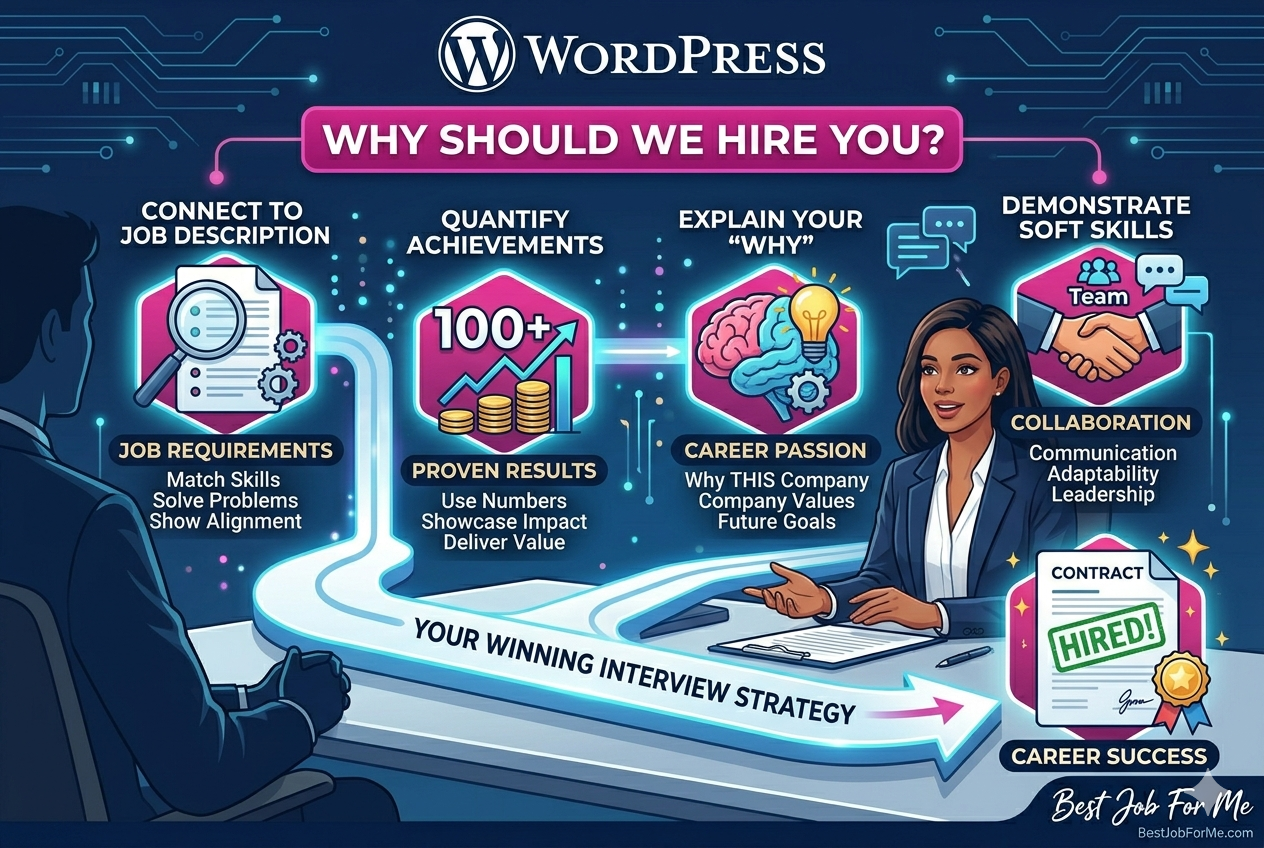
Similarly, your answer to “Why should we hire you?” should explain the value you can provide now, while your five-year answer focuses more on how you hope to develop in the future.
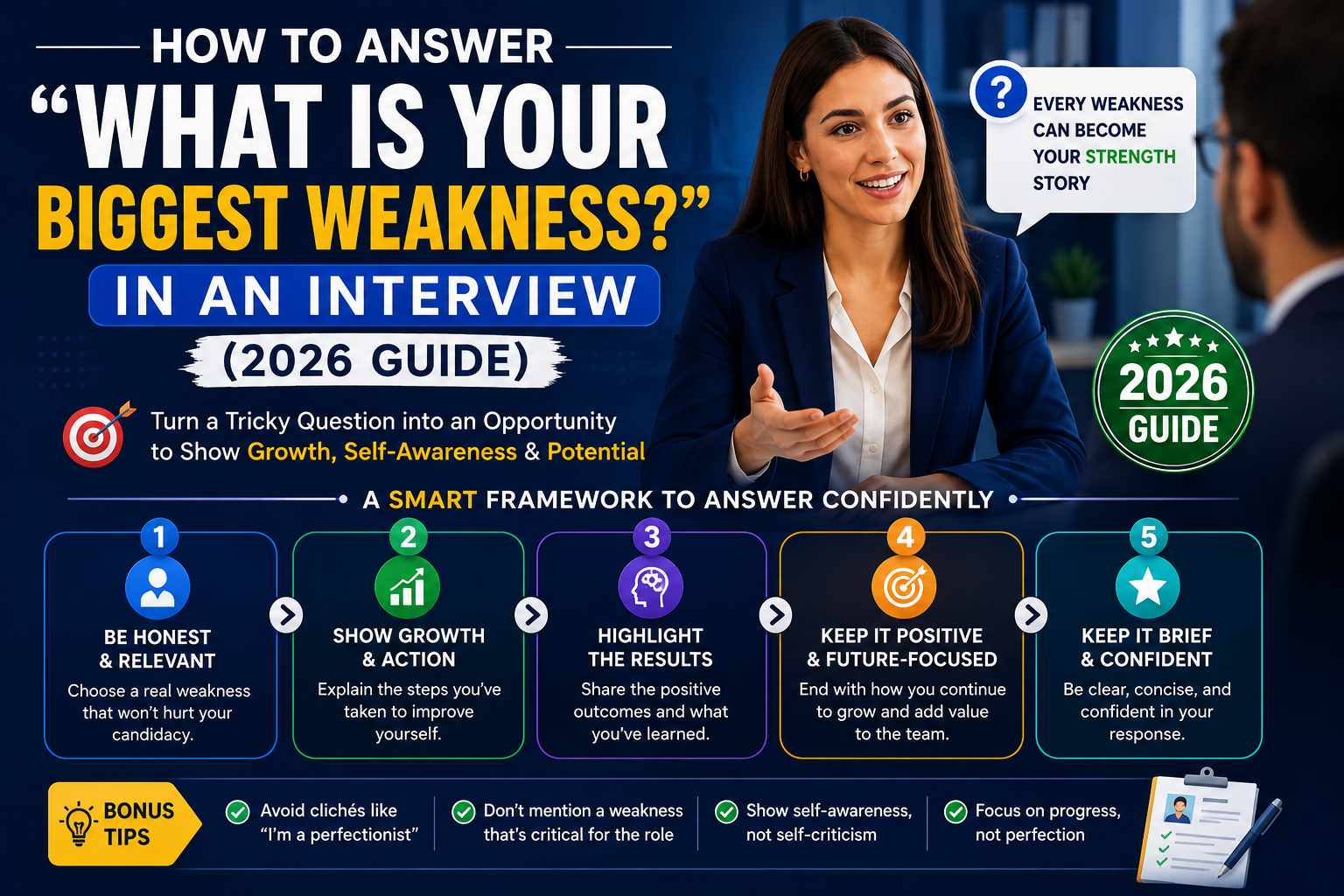
You should also prepare for “What is your biggest weakness?”, because employers often use questions about strengths, weaknesses, goals, and motivation together to understand you as a candidate.
Quick Checklist for a Strong Answer
Before your interview, make sure your response:
- Focuses on professional growth
- Includes realistic goals
- Shows enthusiasm for learning
- Relates to the position
- Demonstrates increasing responsibility
- Avoids demanding a specific promotion
- Does not focus primarily on money
- Sounds natural rather than memorized
- Can be delivered in roughly one minute
If your answer checks most of these boxes, you are in a strong position.
Frequently Asked Questions
What is the best answer to “Where do you see yourself in 5 years?”
The best answer explains how you want to develop professionally while connecting those goals to the position. Focus on building skills, gaining experience, taking on greater responsibility, and contributing more value over time.
Should I say I want to be a manager in five years?
You can mention leadership as a goal, but avoid presenting a promotion as something you automatically expect. Explain that you would like to move toward leadership as you gain experience and demonstrate strong performance.
What if I don’t know where I’ll be in five years?
You do not need to know your exact future position. Focus on the skills you want to develop, the responsibilities you hope to gain, and the general direction you want your career to take.
Can I say I want to stay with the company for five years?
Yes, if that is genuinely your intention. However, you do not need to make a specific promise. It is usually better to explain why you see opportunities to learn and grow within the organization.
Should freshers have a five-year career plan?
Freshers do not need a detailed five-year plan. A good answer can focus on learning, gaining practical experience, becoming skilled in the profession, and gradually taking on greater responsibilities.
Should I mention salary in my five-year answer?
Usually, no. Employers understand that compensation matters, but this question is primarily about career direction and professional development. Focus on skills, responsibilities, achievements, and growth.
Final Thoughts
You do not need to predict the future to answer “Where do you see yourself in 5 years?” successfully.
Employers are mainly trying to understand whether you have professional goals and whether the job they are offering makes sense as part of those goals.
Keep your answer realistic. Talk about the skills you want to develop, the responsibilities you hope to earn, and the contribution you want to make as you become more experienced.
Most importantly, connect your future goals with the opportunity in front of you.
A candidate who can explain both what they can contribute today and how they want to grow tomorrow gives an interviewer a much clearer reason to see them as a long-term addition to the team.