How to Set Career Goals and Actually Achieve Them
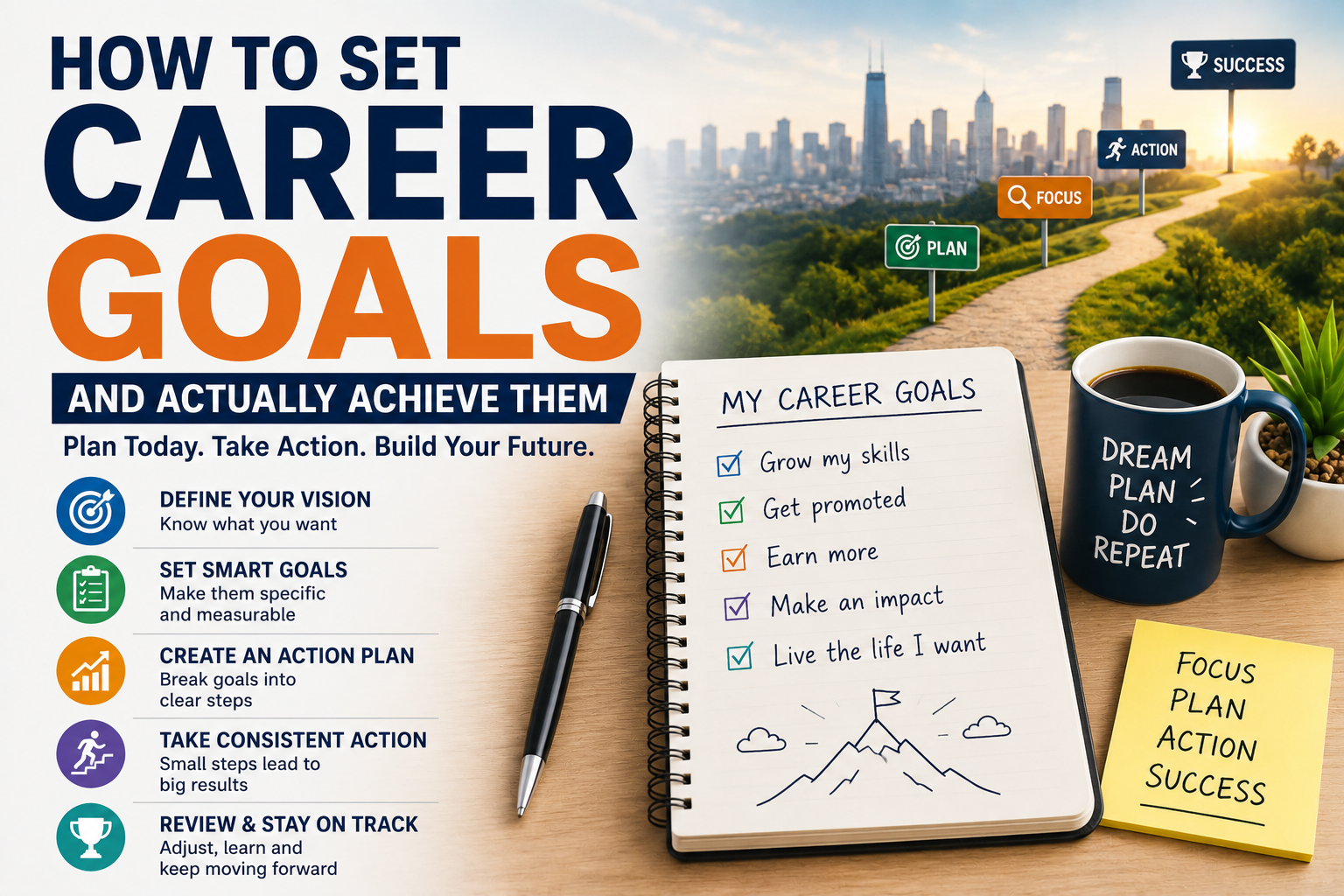
Setting career goals can give you direction when you’re unsure what to do next professionally. Whether you want to get your first job, earn a promotion, change careers, develop a new skill, or move into leadership, a clear goal can turn a general ambition into something you can actually work toward.
Stay connected
Add us as a trusted source on Google
Get our latest guides, updates, and helpful resources surfaced more often when you search and browse.
The problem is that many career goals are too vague.
You might tell yourself:
“I want a better job.”
“I want to earn more.”
“I want to become successful.”
These are reasonable ambitions, but they don’t tell you what to do tomorrow, next week, or next month.
Effective career goals are different. They identify where you want to go, why it matters, and what steps will help you get there.
In this guide, you’ll learn how to set career goals, create realistic short-term and long-term objectives, build an actionable career plan, and stay on track when your priorities change.
What Are Career Goals?
Career goals are professional objectives you want to achieve during your working life.
They can be relatively small, such as completing a certification, or much larger, such as becoming a department manager.
Examples include:
- Getting your first full-time job
- Learning a new professional skill
- Moving into a management position
- Changing careers
- Increasing your salary
- Earning an industry certification
- Building a professional network
- Becoming an expert in a particular field
- Starting a business
- Moving into remote work
- Improving your communication skills
- Taking responsibility for larger projects
Your goals don’t need to impress anyone else.
A useful career goal should reflect what you want from your professional life.
Why Are Career Goals Important?
Without a clear direction, it’s easy to spend years reacting to whatever opportunity appears next.
Career goals help you make more deliberate decisions.
For example, suppose you’re offered two jobs.
One pays slightly more today, while the other provides experience in the field you eventually want to enter.
If you know your long-term career goal, evaluating those opportunities becomes easier.
Career goals can help you:
- Prioritize learning
- Choose relevant jobs
- Decide which skills to develop
- Measure professional progress
- Identify useful opportunities
- Stay motivated
- Make better career decisions
A goal doesn’t guarantee success, but it gives you something specific to work toward.
Short-Term vs. Long-Term Career Goals
A strong career plan usually includes both short-term and long-term goals.
What Are Short-Term Career Goals?
Short-term career goals are objectives you can reasonably work toward in the near future.
Examples include:
- Updating your resume
- Completing a professional course
- Improving your LinkedIn profile
- Building a portfolio
- Learning a new software tool
- Applying for internships
- Improving public speaking
- Taking responsibility for a new project
- Making new professional connections
Short-term goals create momentum.
They are particularly useful because you can often see progress relatively quickly.
What Are Long-Term Career Goals?
Long-term goals describe where you would like your career to develop over several years.
Examples might include:
- Becoming a manager
- Moving into a new profession
- Becoming a subject-matter expert
- Leading a department
- Building a successful freelance career
- Starting a company
- Reaching a particular level of responsibility
Long-term goals provide direction, while short-term goals help you move toward them.
How to Set Career Goals
Choosing a goal shouldn’t begin with what sounds impressive.
It should begin with understanding what you actually want.
Step 1: Think About What You Want From Your Career
Ask yourself:
- What type of work do I enjoy?
- What am I naturally good at?
- Which skills would I like to develop?
- What kind of work environment suits me?
- How important is flexibility?
- Do I want to manage people?
- What level of responsibility do I want?
- How important is income growth?
- Do I prefer stability or variety?
- What would make me feel that my career is progressing?
Don’t worry about creating perfect answers.
The purpose is to identify patterns.
For example, you might discover that autonomy and flexibility matter more to you than becoming a manager.
Someone else may realize that leadership is one of their biggest professional ambitions.
Neither goal is automatically better.
Step 2: Choose a Clear Career Direction
Once you’ve thought about your priorities, turn them into a direction.
Instead of:
“I want a good career.”
try:
“I want to build a career in digital marketing.”
Instead of:
“I want a better position.”
try:
“I want to move from individual contributor to team leader.”
Instead of:
“I want to earn more.”
try:
“I want to develop the skills required to qualify for higher-level data analyst positions.”
Specific goals make planning easier.
If you’re still unsure about your direction, spend more time learning how to choose the right career path before committing to a major long-term goal.
Step 3: Make Your Goal Specific
Consider this goal:
“I want to improve my skills.”
Which skills?
Why?
How will you know when you’ve improved?
A stronger version might be:
“I want to improve my presentation skills so I can confidently present project results to clients and senior managers.”
Now the goal has context.
You know what you’re improving and why it matters.
Step 4: Make Sure You Can Measure Progress
Not every career goal can be measured with a simple number, but you should still be able to recognize progress.
Suppose your goal is:
“Become better at public speaking.”
Possible progress indicators could include:
- Completing a presentation course
- Delivering five team presentations
- Volunteering to present at meetings
- Presenting to a client
- Requesting feedback after presentations
Instead of waiting for a vague feeling that you’ve “become better,” you have evidence of improvement.
Step 5: Check Whether the Goal Is Realistic
Ambitious goals can be motivating.
Unrealistic goals can become discouraging.
Suppose you’re learning programming for the first time.
Setting a goal to become a senior software engineer within three months probably isn’t realistic.
A better first goal could be:
“Learn programming fundamentals and build three small projects.”
Once you achieve that, you can set the next goal.
Being realistic doesn’t mean thinking small.
It means understanding the steps required between your current position and your desired outcome.
Step 6: Give Your Goal a Time Frame
A goal without any time frame is easy to postpone.
Compare:
“I’ll update my resume someday.”
with:
“I’ll update my resume before Friday and begin applying for relevant positions next week.”
A time frame creates urgency.
You don’t need to predict exactly when you’ll achieve every long-term goal.
Use deadlines for the actions you can control.
For example:
- Complete course by the end of the month
- Build first portfolio project within six weeks
- Attend one networking event this month
- Update resume this weekend
- Apply for five carefully selected positions this week
These deadlines turn intention into action.
Step 7: Break Large Goals Into Smaller Milestones
Large career goals can feel overwhelming.
Suppose your long-term goal is:
Become a data analyst.
That might require several smaller milestones:
- Learn spreadsheet analysis.
- Learn SQL.
- Develop basic statistics knowledge.
- Learn a visualization tool.
- Complete several data projects.
- Build a portfolio.
- Update your resume.
- Begin applying for entry-level roles.
- Practice interview questions.
“Become a data analyst” may take considerable time.
“Complete an introductory SQL course” is something you can start today.
Small milestones make large goals manageable.
Step 8: Identify the Skills You’ll Need
Every career goal requires something from you.
Ask:
What would someone who has already achieved this goal know or be able to do that I can’t do yet?
The answer reveals your skill gaps.
For example, if your goal is to become a manager, you might need stronger:
- Leadership
- Communication
- Delegation
- Decision-making
- Conflict resolution
- Project management
- Problem-solving skills
If your goal is to become a web developer, your skill requirements will be completely different.
Review job descriptions for positions you eventually want.
Look for skills and qualifications that appear repeatedly.
That gives you a practical development checklist.
Step 9: Create an Action Plan
A career goal becomes much more useful when it has actions attached to it.
Your plan doesn’t need to be complicated.
For each goal, write:
Goal: What do I want to achieve?
Why: Why does this matter to me?
Skills: What do I need to learn?
Actions: What will I do?
Deadline: When will I complete the next milestone?
Evidence: How will I know I’ve made progress?
For example:
Goal: Move into a project-management role.
Why: I enjoy organizing work, coordinating teams, and taking responsibility for outcomes.
Skills needed: Planning, stakeholder communication, risk management, budgeting, and project-management tools.
Actions: Complete relevant training, manage a small internal project, learn project-management software, and document project results.
Next milestone: Volunteer to coordinate an upcoming team project.
This turns an ambition into a practical plan.
Step 10: Build Habits That Support Your Goal
Career progress doesn’t always come from dramatic decisions.
Small actions repeated consistently can create significant results.
If your goal requires learning, schedule regular learning time.
If networking matters, connect with professionals consistently rather than sending dozens of messages once every six months.
If you’re looking for a job, create a routine for researching and applying for relevant positions.
Useful habits might include:
- Learning for 30 minutes each day
- Reading industry news
- Practicing a technical skill
- Updating your portfolio regularly
- Connecting with one professional each week
- Reviewing job descriptions
- Tracking accomplishments at work
- Asking for feedback
Small professional habits can gradually make you more employable and move you closer to larger goals.
Step 11: Track Your Progress
Don’t create a career plan and then forget about it.
Review it regularly.
Ask:
- What have I completed?
- What am I currently working on?
- What is taking longer than expected?
- What have I learned?
- Is this goal still important to me?
- What should I do next?
You can track progress in a notebook, spreadsheet, task-management app, or simple document.
The tool doesn’t matter.
Consistency does.
Step 12: Adjust Your Goals When Necessary
Changing a career goal doesn’t mean you’ve failed.
You may learn something new about yourself.
The industry may change.
A new opportunity may appear.
You may discover that you dislike the work you originally planned to pursue.
Career goals should provide direction, not trap you.
For example, you might begin learning web development and discover that you enjoy infrastructure and servers more than application development.
That insight could lead you toward web hosting, cloud support, system administration, or DevOps.
Your original goal still helped because it exposed you to a better direction.
Examples of Career Goals
Your goals will depend on your career stage.
Career Goals for Students
Examples include:
- Complete an internship
- Build a portfolio
- Improve communication skills
- Learn an industry-relevant tool
- Attend career events
- Build professional connections
- Identify three potential career paths
Students don’t need their entire careers planned.
Exploration itself can be a useful goal.
Career Goals for Freshers
Freshers might focus on:
- Getting their first professional job
- Building practical experience
- Improving their resume
- Developing workplace communication
- Learning industry tools
- Finding a mentor
- Completing relevant certifications
Your first goal doesn’t need to be reaching a senior position.
Building a strong professional foundation is valuable.
Career Goals for Experienced Professionals
Possible goals include:
- Earning a promotion
- Leading larger projects
- Becoming a manager
- Developing specialist expertise
- Increasing compensation
- Mentoring junior colleagues
- Moving into another department
- Improving leadership skills
Experienced professionals should think about both the next position and the capabilities required to succeed in it.
Career Goals for Career Changers
If you’re changing professions, your goals might include:
- Researching target careers
- Identifying transferable skills
- Closing skill gaps
- Completing relevant projects
- Building a new professional network
- Rewriting your resume
- Getting your first role in the new field
A career transition becomes easier when you treat it as a series of smaller goals rather than one giant leap.
If this describes your situation, our guide on how to change careers can help you plan the transition step by step.
Career Goal Examples for an Interview
Interviewers sometimes ask:
“What are your career goals?”
or:
“Where do you see yourself in five years?”
They aren’t necessarily expecting a detailed life plan.
They want to understand whether:
- You’re motivated
- The job fits your direction
- You want to develop professionally
- Your expectations are realistic
A good answer connects your development with the opportunity.
For example:
“My immediate goal is to strengthen my experience in digital marketing and take responsibility for larger campaigns. Over time, I’d like to develop deeper expertise in strategy and eventually mentor or lead other team members. This position interests me because it would allow me to build those skills while contributing to real campaigns.”
The answer shows ambition without pretending that your future is completely predictable.
What If You Don’t Know Your Career Goals?
That’s more common than you might think.
Don’t force yourself to choose a lifelong career immediately.
Start with exploration goals.
For example:
Goal 1: Research five careers that match my strengths.
Goal 2: Speak with three people working in those professions.
Goal 3: Complete a small project related to my top choice.
Goal 4: Review real job descriptions and identify common requirements.
You can make progress even when your final destination isn’t clear.
Sometimes clarity comes from action rather than thinking.
What If You Fail to Reach a Career Goal?
Missing a goal doesn’t automatically mean you failed.
Review what happened.
Maybe:
- The deadline was unrealistic.
- You underestimated the skills required.
- Your priorities changed.
- You didn’t have enough time.
- You chose the wrong learning method.
- The opportunity you expected didn’t appear.
Then adjust.
Suppose you planned to change careers within six months but discover that employers consistently require a skill you don’t yet have.
Your next goal becomes developing that skill.
Career planning works best as an ongoing process.
Common Career Goal Mistakes
Setting Goals Based on Other People’s Expectations
Your family, friends, coworkers, and social media can influence what you think success should look like.
Make sure your goals reflect what matters to you.
Choosing Only Salary Goals
Income is important, but salary alone doesn’t describe a career.
Also consider:
- Work you enjoy
- Career growth
- Flexibility
- Stability
- Responsibility
- Learning
- Work environment
Setting Too Many Goals
Trying to learn five skills, change careers, start freelancing, earn a promotion, and build a business simultaneously can divide your attention.
Prioritize.
Focusing Only on Outcomes
Some outcomes aren’t entirely under your control.
You can’t guarantee that an employer will promote you next month.
You can control whether you develop leadership skills, take responsibility for projects, document your achievements, and discuss advancement with your manager.
Focus heavily on actions you control.
Never Reviewing Your Goals
A career plan created several years ago may no longer fit your priorities.
Review it periodically.
Frequently Asked Questions
What are career goals?
Career goals are professional objectives you want to achieve, such as developing a skill, earning a promotion, changing careers, becoming a manager, finding your first job, or becoming an expert in your field.
How do I set career goals?
Start by identifying what you want from your career. Choose a specific direction, make the goal measurable where possible, break it into smaller milestones, identify required skills, create an action plan, and regularly review your progress.
What are good short-term career goals?
Good short-term goals include updating your resume, completing a certification, improving a professional skill, building a portfolio project, attending networking events, or taking responsibility for a new project.
What are examples of long-term career goals?
Examples include becoming a manager, moving into a new profession, building specialist expertise, starting a business, becoming a senior professional, or developing a successful freelance career.
How many career goals should I have?
There’s no perfect number. Having one or two major priorities with several supporting milestones is often easier to manage than pursuing many unrelated goals simultaneously.
Can career goals change?
Yes. Career goals should evolve as you gain experience, learn more about yourself, and encounter new opportunities. Adjusting a goal based on new information is part of good career planning.
Final Thoughts
Learning how to set career goals can give you greater control over your professional development.
You don’t need to know exactly where you’ll be ten years from now.
Start with what you know today.
Decide what you want to improve, identify the next meaningful milestone, and create actions that move you toward it.
Your first step might be completing a course, updating your resume, starting a project, talking to someone in your target profession, or simply researching your options.
Then review what you’ve learned and choose the next step.
A strong career isn’t usually built through one perfect decision. It’s built through a series of useful decisions that gradually move you in the right direction.