How to Prepare for a Remote Job Interview: Questions, Answers & Tips
Remote job interviews have a lot in common with traditional job interviews, but employers are often evaluating something extra: whether you can work effectively when your manager and coworkers are not sitting in the same office.
Stay connected
Add us as a trusted source on Google
Get our latest guides, updates, and helpful resources surfaced more often when you search and browse.
That means preparing for a remote job interview involves more than practicing common interview questions.
You may need to demonstrate that you can communicate clearly, manage your time, work independently, stay organized, solve problems, and collaborate with people across different locations or time zones.
You also need to be comfortable interviewing through video.
Technical problems, poor audio, distracting backgrounds, and weak internet connections can create a bad first impression before you even start answering questions.
The good news is that most of these problems are preventable.
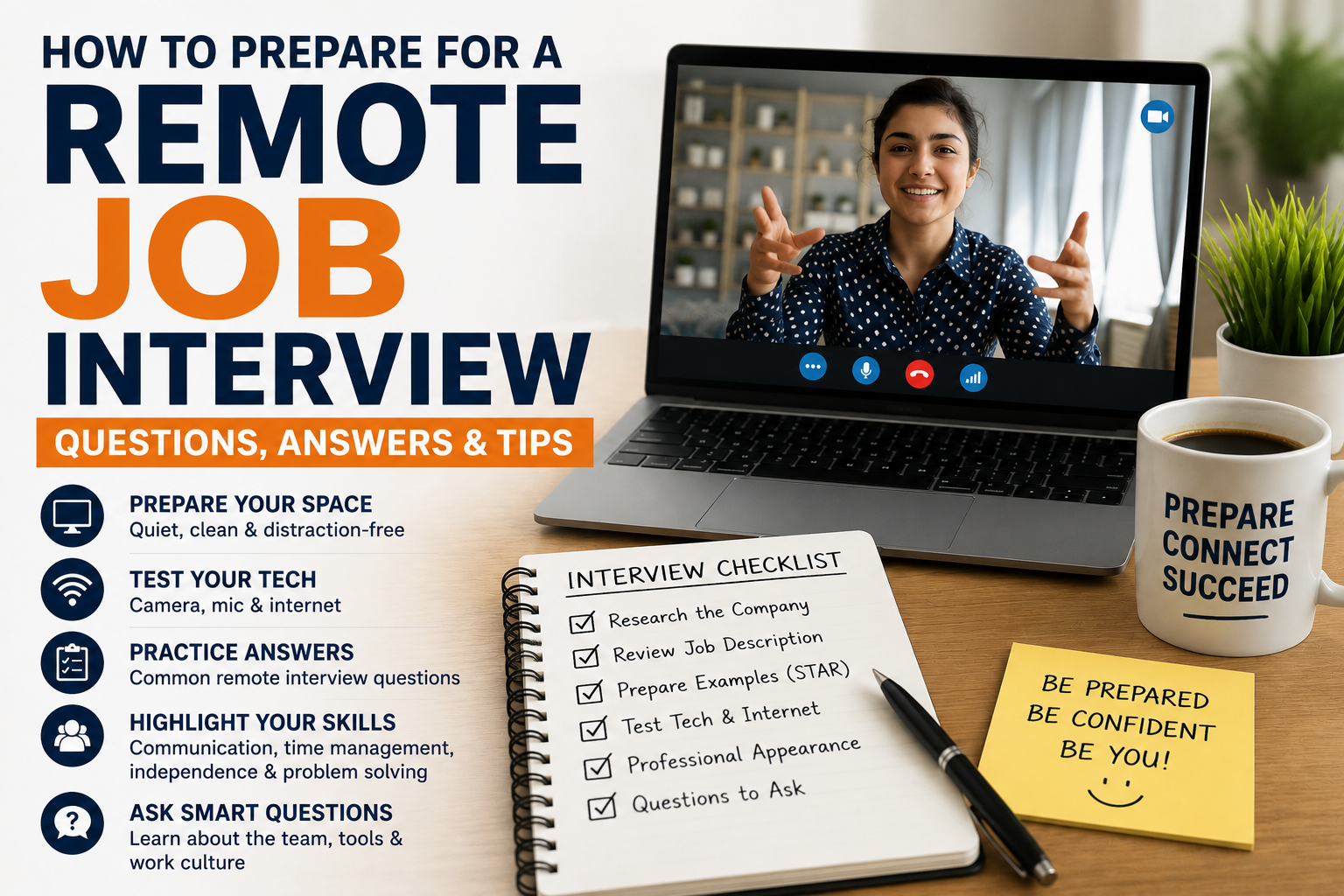
In this guide, you’ll learn how to prepare for a remote job interview, common remote interview questions you may be asked, sample answers, video interview tips, mistakes to avoid, and questions you should ask the employer before accepting a remote position.
What Is a Remote Job Interview?
A remote job interview is an interview conducted without meeting the employer in person.
Most remote interviews happen through video conferencing, although some companies may begin with a phone interview.
The hiring process could include:
- An initial recruiter call
- Video interview with the hiring manager
- Technical or skills assessment
- Interview with potential teammates
- Final interview
- Job offer
For a fully remote position, you may complete the entire hiring process without visiting an office.
Because the employer cannot meet you face-to-face, your communication and preparation become especially important.
How Is a Remote Interview Different From an In-Person Interview?
The questions themselves may be similar.
You could still be asked about:
- Your experience
- Your strengths
- Your weaknesses
- Your accomplishments
- Your career goals
- Why you want the job
- Why you want to work for the company
But remote employers may also want to know whether you can succeed outside a traditional office.
They may ask about your ability to:
- Work independently
- Communicate asynchronously
- Manage your schedule
- Prioritize tasks
- Stay productive
- Use remote collaboration tools
- Solve problems without immediate supervision
- Work with distributed teams
- Handle different time zones
Your answers should demonstrate that you understand what successful remote work actually requires.
How to Prepare for a Remote Job Interview
Preparation can make a significant difference in how confident and professional you appear.
Here are the most important steps.
1. Research the Company
Researching the employer is important for any interview, but it’s particularly important when applying for remote jobs.
Unfortunately, fake remote job advertisements exist.
Before attending an interview, verify that you’re communicating with a legitimate organization.
Start with the company’s official website.
Learn about:
- What the company does
- Products or services
- Customers
- Company size
- Industry
- Leadership
- Recent developments
- Company culture
- Remote-work policies
Then verify that the person contacting you appears to be associated with the organization.
Pay attention to the recruiter’s email address.
An email from an official company domain is generally more credible than an unexpected message from a generic personal account.
You should also check whether the position appears on the company’s official careers page when possible.
If something about the opportunity feels suspicious, don’t ignore it.
Before continuing with an unfamiliar employer, learn how to spot fake remote jobs and recognize common warning signs.
2. Read the Job Description Carefully
Don’t prepare for the interview based only on the job title.
Read the entire job description again.
Identify the employer’s most important requirements.
Look for:
- Required technical skills
- Communication expectations
- Years of experience
- Software knowledge
- Responsibilities
- Required working hours
- Time-zone requirements
- Collaboration expectations
- Travel requirements
Highlight requirements that appear more than once.
These are often particularly important to the employer.
Next, think of examples from your experience that demonstrate those skills.
For example, if the employer repeatedly mentions independent problem solving, prepare a story showing how you solved a problem without needing constant direction.
If communication appears throughout the description, prepare an example demonstrating how you communicated effectively with teammates, customers, or managers.
3. Research Your Interviewers
If you know who will be interviewing you, learn a little about their professional background.
You don’t need to investigate their personal life.
Simply understanding their role can help you anticipate the conversation.
For example, an HR recruiter may focus more on your experience, expectations, and overall fit.
A technical manager may ask detailed questions about your skills and previous projects.
A future teammate may want to understand how you communicate and collaborate.
Knowing who you’re speaking with can help you prepare relevant examples.
4. Test Your Technology Before the Interview
Don’t wait until five minutes before the interview to discover that your microphone doesn’t work.
Test everything beforehand.
Check your:
- Computer
- Webcam
- Microphone
- Speakers or headphones
- Internet connection
- Interview software
- Browser permissions
- Battery or charger
If the employer sends you a meeting link, confirm which platform will be used.
Install any required software ahead of time.
Test your camera and microphone using the same device you plan to use during the interview.
5. Have a Backup Plan
Technology sometimes fails even when you’ve prepared properly.
Your internet connection could drop.
Your computer could restart unexpectedly.
Your microphone could stop working.
Have a backup plan.
For example:
- Keep your phone nearby.
- Make sure the interviewer’s contact information is accessible.
- Have the meeting application installed on your phone if possible.
- Keep your laptop connected to power.
- Know whether you can switch to mobile data if necessary.
If a technical problem occurs, stay calm.
Remote employers understand that occasional technical issues happen.
How you respond to the problem can say something about your ability to handle unexpected situations.
6. Choose a Quiet Interview Location
Find a location where you are unlikely to be interrupted.
Ideally, your interview space should have:
- Minimal background noise
- Good lighting
- A clean background
- Reliable internet
- A comfortable chair
- Enough privacy to speak freely
Tell other people in your home when the interview is happening if interruptions are possible.
Silence unnecessary notifications on your computer and phone.
You don’t need an expensive home office.
You simply need an environment that allows you to communicate professionally.
7. Check Your Camera Position
Place your camera close to eye level.
A laptop placed very low on a desk can create an awkward camera angle.
If necessary, place the laptop on a stable stand or a few sturdy books.
Frame yourself so your head and upper shoulders are clearly visible.
Avoid sitting extremely close to the camera.
Look at the camera occasionally when speaking rather than watching your own image throughout the entire conversation.
This can create more natural eye contact.
8. Make Sure Your Face Is Well Lit
Lighting can make a major difference in video quality.
Whenever possible, position a light source in front of you rather than behind you.
Sitting directly in front of a bright window can make your face appear dark.
Natural light can work well, but make sure changing sunlight won’t create problems during the interview.
Test your camera beforehand and adjust your position until your face is clearly visible.
9. Dress Professionally
A remote interview is still a professional interview.
Choose clothing appropriate for the organization and position.
You don’t necessarily need to wear a formal suit for every interview.
A startup and a traditional financial institution may have very different expectations.
When you’re unsure, being slightly more professional is usually safer than being too casual.
And dress professionally beyond what the camera can see.
You don’t want an unexpected situation requiring you to stand up while you’re wearing formal clothing on top and pajamas underneath.
10. Keep Important Information Nearby
One advantage of interviewing from home is that you can keep useful notes nearby.
Prepare:
- A copy of your resume
- The job description
- Key accomplishments
- Questions for the employer
- A pen and notebook
- Important project details
- Relevant numbers or results
Don’t create a complete script and read from it.
Interviewers can usually tell when someone is reading.
Use brief notes as reminders instead.
Common Remote Job Interview Questions and Sample Answers
Remote employers may ask traditional interview questions along with questions specifically designed to evaluate remote-work skills.
Here are some of the most common ones.
1. Why Do You Want to Work Remotely?
This is one of the most predictable remote interview questions.
Avoid focusing only on personal convenience.
For example, saying:
“I want to work remotely because I don’t like commuting.”
may be true, but it doesn’t tell the employer why remote work will make you an effective employee.
A stronger answer connects remote work with your working style.
Sample Answer
“I enjoy remote work because I’m comfortable managing my responsibilities independently and communicating proactively with my team. I like having focused time for deep work while still collaborating regularly through messages, calls, and project-management tools. I’ve found that this working style allows me to stay productive while remaining connected with the rest of the team.”
If you’ve never worked remotely, don’t pretend that you have.
You can instead explain why your existing skills make you well suited to it.
Sample Answer With No Remote Experience
“I haven’t worked in a fully remote position yet, but I’ve had experience managing independent projects and collaborating digitally with classmates and colleagues. I’m comfortable organizing my own schedule, communicating through online tools, and asking questions when I need clarification. Those experiences are part of why I’m interested in moving into remote work.”
2. Have You Worked Remotely Before?
If you have remote experience, explain what you learned from it.
Don’t simply answer yes.
Sample Answer
“Yes. My previous position was remote three days a week. It taught me to be much more deliberate about communication. Instead of assuming teammates knew what I was working on, I started documenting progress and providing short updates when important milestones were reached. That made collaboration much easier.”
If you haven’t worked remotely before, use related experiences.
These could include:
- Online classes
- Freelancing
- Independent projects
- Distributed college projects
- Volunteer work
- Hybrid work
The goal is to show that you have already developed some of the habits required for remote work.
3. How Do You Stay Productive While Working From Home?
Employers want evidence that you can manage yourself without someone constantly checking on you.
A good answer should describe your process.
Sample Answer
“I start by identifying my most important tasks and deadlines for the day. I usually block focused time for work that requires concentration and check communication channels at regular intervals rather than constantly switching between tasks. I also keep my workspace separate from distractions as much as possible. At the end of the day, I review what I’ve completed and what needs to carry over.”
You don’t need to use this exact system.
Explain what genuinely works for you.
4. How Do You Manage Your Time?
Time management is particularly important when employees work independently.
Sample Answer
“I manage my time by prioritizing tasks based on urgency, impact, and deadlines. For larger projects, I break the work into smaller milestones so I can track progress rather than waiting until the final deadline. I also leave some flexibility in my schedule for unexpected requests or problems.”
Specific processes make your answer more believable.
5. How Do You Communicate With a Remote Team?
Remote communication requires more intentional effort because you can’t simply walk over to someone’s desk.
Sample Answer
“I try to choose the communication method based on the situation. Quick updates can usually be handled through messaging, detailed information should be documented, and complicated discussions are sometimes better handled through a call. I also try to provide enough context in my messages so teammates don’t need several follow-up questions just to understand what I’m asking.”
This answer demonstrates an understanding of asynchronous communication.
6. How Do You Handle Miscommunication Remotely?
Misunderstandings can happen more easily when communication happens through text.
Sample Answer
“If I think there’s a misunderstanding, I try not to continue sending increasingly long messages. I first clarify what I understood and ask whether we’re aligned. If the issue is complicated, I suggest a short call. Once we agree on the decision, I like to document the important points so everyone has the same reference afterward.”
This shows both communication and problem-solving skills.
7. How Do You Stay Motivated Without Direct Supervision?
Avoid implying that you need constant monitoring to complete your work.
Sample Answer
“I work best when I have clear objectives and understand what outcome I’m responsible for. I break larger responsibilities into smaller milestones and track my progress against deadlines. I don’t need someone checking every step, but I do value regular feedback so I can make sure my work remains aligned with the team’s priorities.”
8. How Do You Prioritize Multiple Tasks?
Remote workers may receive requests from several people through different communication channels.
Your answer should demonstrate a clear decision-making process.
Sample Answer
“I look at deadlines, business impact, dependencies, and urgency. If two important tasks genuinely conflict, I don’t guess which stakeholder should take priority. I communicate the conflict early and ask for clarification if necessary. That helps prevent surprises later.”
9. What Would You Do If You Were Stuck on a Problem?
Remote employers don’t want employees who immediately ask for help with every small problem.
But they also don’t want someone who spends an entire day stuck because they’re afraid to ask.
A good answer shows balance.
Sample Answer
“I first spend some time understanding the problem and checking the resources available to me, such as documentation, previous examples, or internal knowledge. If I still can’t make progress, I ask for help and explain what I’ve already tried. That usually makes it easier for the other person to help without repeating work I’ve already done.”
This is an excellent opportunity to demonstrate your problem-solving skills.
10. How Do You Handle Working Across Different Time Zones?
If the organization has a distributed workforce, this question can be important.
Sample Answer
“I think documentation becomes especially important when people work in different time zones. I try to leave clear updates explaining what was completed, what still needs attention, and whether anything is blocked. That allows someone in another time zone to continue working without waiting several hours for clarification.”
If the job requires specific overlapping hours, be honest about your availability.
11. What Remote Work Tools Have You Used?
Don’t worry if you haven’t used every tool listed in the job description.
Mention tools you’ve genuinely used.
They could include:
- Video conferencing software
- Team messaging tools
- Project-management platforms
- Cloud document systems
- Shared calendars
- Time-tracking software
- Industry-specific applications
More importantly, demonstrate that you’re comfortable learning new tools.
Sample Answer
“I’ve worked with several communication and project-management platforms. I usually adapt to new software fairly quickly, so if your team uses a platform I haven’t worked with before, I’d be comfortable learning it.”
12. How Do You Maintain Work-Life Balance When Working From Home?
Remote work can blur the boundary between professional and personal time.
Sample Answer
“I try to create clear boundaries around my working hours and workspace. I start the day with a defined task list and finish by reviewing what needs to happen next. Having that end-of-day routine helps me mentally switch out of work mode instead of checking tasks throughout the evening.”
13. Tell Me About a Time You Solved a Problem Independently
Use a real example.
The STAR method can help structure your answer:
Situation: What was happening?
Task: What were you responsible for?
Action: What did you do?
Result: What happened?
Sample Answer
“During a project, I noticed that customer requests were repeatedly being assigned to the wrong team, which was creating delays. I reviewed several recent cases and found that the instructions in our intake form were unclear. I suggested revised categories and clearer descriptions, then tested the updated process with the team. The change reduced incorrect assignments and made requests easier to manage.”
Your example doesn’t need to come from remote work.
Employers are evaluating the underlying skill.
14. How Do You Handle Distractions While Working From Home?
Don’t claim you never get distracted.
Instead, explain how you manage distractions.
Sample Answer
“I try to reduce distractions before they become a problem. I work from a dedicated area, keep unnecessary notifications turned off during focused work, and schedule breaks rather than checking unrelated things throughout the day. If something requires particularly deep concentration, I block that time on my calendar.”
15. Why Should We Hire You for This Remote Position?
Connect your qualifications to both the job and remote work.
Sample Answer
“My experience matches the core responsibilities of the position, particularly customer communication and problem solving. I also think my working style fits a remote environment because I’m comfortable organizing my own priorities, documenting my work, and communicating proactively when something needs attention. I believe I could contribute independently while still being an active member of the team.”
How to Answer Remote Interview Questions With No Experience
One of the biggest misconceptions about remote jobs is that you need previous remote employment to qualify.
That’s not always true.
Employers primarily need evidence that you possess the skills required to succeed remotely.
Think about situations where you’ve demonstrated:
- Independence
- Reliability
- Communication
- Organization
- Time management
- Problem solving
- Adaptability
- Technical confidence
Maybe you completed a college project where everyone worked from different locations.
Perhaps you’ve completed online courses independently.
Maybe you’ve built personal projects without supervision.
You could have volunteered for an organization and coordinated work online.
These experiences can still demonstrate remote-ready skills.
Instead of saying:
“I’ve never worked remotely, so I don’t know.”
try:
“I haven’t held a fully remote position yet, but I’ve developed several of the skills that remote work requires. For example…”
Then provide evidence.
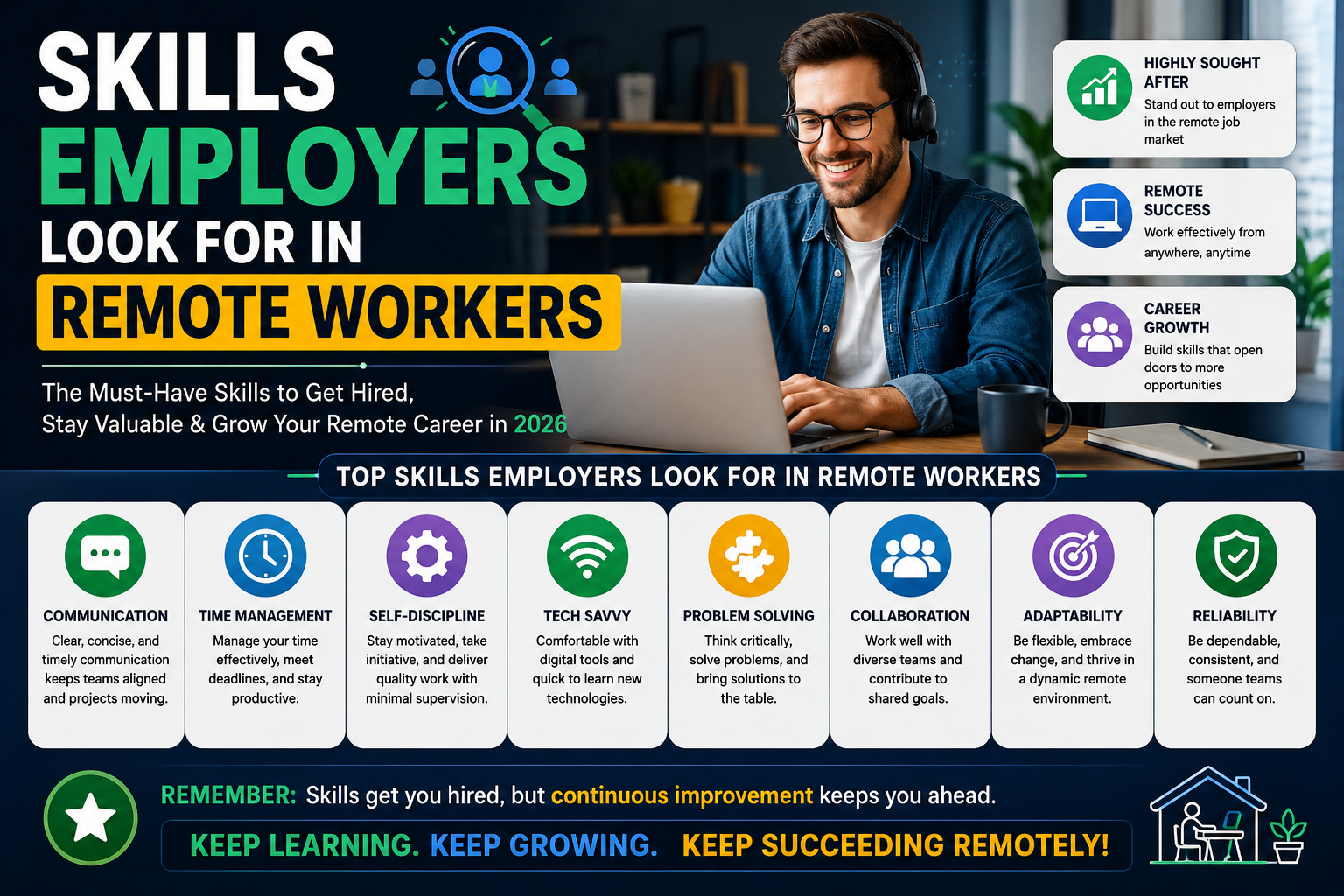
Skills Remote Employers Look for During Interviews
Your technical qualifications matter, but remote employers may pay particular attention to certain professional skills.
Communication
Can you explain ideas clearly?
Do you listen carefully?
Can you communicate without requiring constant meetings?
Time Management
Can you organize your day and meet deadlines?
Independence
Can you make progress without someone constantly monitoring you?
Reliability
Can teammates depend on you to complete what you’ve promised?
Problem Solving
Can you investigate an issue before immediately asking someone else to solve it?
Adaptability
Can you adjust when priorities, tools, or circumstances change?
Collaboration
Can you work effectively with people you rarely or never meet in person?
These are some of the same skills employers look for in remote workers, so prepare examples that demonstrate them before your interview.
How to Use the STAR Method in a Remote Job Interview
Behavioral questions often begin with phrases such as:
- “Tell me about a time…”
- “Give me an example…”
- “Describe a situation…”
- “What did you do when…”
The STAR method can help you answer without rambling.
Situation
Briefly explain the context.
Task
Explain what you needed to accomplish.
Action
Describe what you did.
This should usually be the largest part of your answer.
Result
Explain what happened.
Whenever possible, include a concrete outcome.
For example:
“Our team was missing project updates because information was spread across several communication channels. I suggested creating one shared project tracker and introduced a simple update format. After we adopted it, everyone could see current responsibilities and blockers in one place, which reduced repeated status questions.”
Prepare several STAR stories before your interview.
One story may be adaptable to multiple questions.
Questions to Ask in a Remote Job Interview
An interview isn’t only an opportunity for the employer to evaluate you.
You should also determine whether the company and remote position are right for you.
When the interviewer asks:
“Do you have any questions for us?”
don’t automatically say no.
Ask questions that help you understand how the team actually works.
1. Is the Position Fully Remote?
Don’t assume “remote” means you can work from anywhere.
Ask whether the position is:
- Fully remote
- Hybrid
- Temporarily remote
- Remote within a particular country
- Remote within specific states or regions
Clarify this before accepting an offer.
2. Are There Required Working Hours?
Ask whether employees can choose their schedules or must be online during specific hours.
A company might advertise flexible work while still requiring everyone to be available during core business hours.
That’s not necessarily a problem.
You simply need to know the expectation.
3. Which Time Zone Does the Team Work In?
This becomes especially important for international teams.
A remote job may technically allow you to work from your location while requiring meetings at inconvenient hours.
Ask about normal meeting times and expected overlap.
4. How Does the Team Communicate?
Find out how employees normally share information.
You could ask:
“How does the team balance meetings with asynchronous communication?”
The answer can reveal a lot about the company’s remote culture.
5. How Is Performance Measured?
This is a particularly useful question.
Strong remote organizations usually focus on outcomes rather than whether someone’s status indicator appears online all day.
Ask:
“How do you measure success in this role?”
The answer helps you understand exactly what the employer expects.
6. How Often Does the Team Meet?
Some remote teams have very few meetings.
Others spend several hours every day on video calls.
Neither approach is automatically right or wrong, but you should understand the culture.
7. What Does Onboarding Look Like for Remote Employees?
Remote onboarding can be challenging when it isn’t organized properly.
Ask how new employees learn:
- Company processes
- Internal systems
- Team responsibilities
- Communication expectations
- Their role
A structured onboarding process can make your first weeks significantly easier.
8. Does the Company Provide Remote-Work Equipment?
Ask what equipment the employer provides.
Depending on the organization, this might include:
- Laptop
- Monitor
- Headset
- Keyboard
- Software
- Home-office allowance
Never assume you’ll receive equipment unless the employer confirms it.
Also be cautious if an unfamiliar employer sends you a check and instructs you to purchase equipment from a specific seller. That can be a warning sign of a job scam.
9. How Does the Team Handle Career Development?
Remote employees should still have opportunities to learn and advance.
You could ask:
“How do managers support professional development for remote employees?”
This helps you understand whether remote workers have clear opportunities for growth.
10. What Are the Biggest Challenges the Remote Team Is Currently Facing?
This can produce useful information you won’t find in the job advertisement.
It may also give you another opportunity to explain how your experience could help.
Remote Interview Red Flags to Watch For
The interview is also an opportunity to evaluate whether the job appears legitimate and professional.
Be cautious if:
- The interviewer refuses to appear on video without explanation.
- The entire “interview” happens through text messages.
- You’re offered the job almost immediately.
- Nobody asks meaningful questions about your experience.
- The interviewer can’t clearly explain the position.
- You’re asked to pay for training.
- You’re asked to purchase equipment from a specific seller using money they send you.
- You’re asked for sensitive financial information unusually early.
- The email domain doesn’t match the organization.
- The compensation seems unrealistic for the role.
- You’re pressured to make an immediate decision.
One unusual detail doesn’t automatically prove a job is fraudulent.
But several warning signs together should make you investigate further.
Our guide on how to spot fake remote jobs explains the most common remote-job scams in greater detail.
Remote Interview Mistakes to Avoid
Even qualified candidates can hurt their chances through avoidable mistakes.
Joining Late
Treat a video interview like an in-person appointment.
Be ready several minutes early.
Testing Technology at the Last Minute
Check your microphone, camera, and software well before the interview.
Reading Answers From a Script
Notes are useful.
Reading entire answers usually isn’t.
It makes your responses sound unnatural and can interfere with eye contact.
Looking at Yourself Constantly
It’s natural to glance at your own video.
But try to focus primarily on the interviewer and occasionally look directly at the camera while speaking.
Giving Extremely Long Answers
Remote conversations can become especially awkward when one person talks continuously.
Answer the question directly, provide relevant evidence, and stop.
Interrupting the Interviewer
Small video delays can make interruptions more common.
Allow a brief moment after the interviewer finishes speaking before answering if the connection appears delayed.
Ignoring Your Environment
Your background doesn’t need to look perfect.
But avoid obvious distractions, loud televisions, constant notifications, or people repeatedly walking behind you.
Focusing Only on the Benefits of Remote Work
Don’t spend the interview talking about avoiding commuting or working in comfortable clothes.
Employers want to know how you’ll help them.
Focus on your ability to perform the job effectively in a remote environment.
What to Do on the Day of Your Remote Interview
Give yourself enough preparation time so you aren’t rushing.
About 30 minutes before the interview:
- Restart your computer if necessary.
- Close unnecessary applications.
- Silence notifications.
- Check your internet connection.
- Test your microphone.
- Test your camera.
- Check lighting.
- Open the job description.
- Keep your resume nearby.
- Prepare water.
- Put your phone on silent.
- Make sure your meeting link works.
Then stop preparing.
Use the remaining few minutes to settle in rather than trying to memorize another answer.
What to Do After a Remote Job Interview
Your work isn’t necessarily finished when the video call ends.
Write Down Important Details
While the conversation is fresh, note:
- Who interviewed you
- Important responsibilities discussed
- Questions you struggled with
- Information about the team
- Next steps
- Anything you promised to send
These notes become especially useful if you’re invited to another interview.
Send a Thank-You Message
If you have the interviewer’s appropriate contact information, consider sending a short thank-you email.
Keep it simple.
Thank them for their time, mention something specific you discussed, and briefly reinforce your interest in the position.
Review Your Performance
Ask yourself:
- Which answers went well?
- Which questions were difficult?
- Did I explain my experience clearly?
- Did I provide enough examples?
- What would I answer differently next time?
Even if you don’t receive the offer, every interview can improve your performance in the next one.
Continue Your Job Search
Don’t stop applying for jobs because one interview went well.
Until you’ve received and accepted a legitimate offer, continue exploring other opportunities.
If you’re still building your pipeline, follow a structured approach for how to find a remote job rather than depending on one application at a time.
Remote Job Interview Checklist
Before your interview, make sure you can check off the following:
- Researched the company
- Verified the job appears legitimate
- Reviewed the job description
- Researched the interviewer if known
- Prepared examples of relevant accomplishments
- Practiced common interview questions
- Prepared several STAR stories
- Tested camera and microphone
- Checked internet connection
- Installed required software
- Prepared a backup device or connection
- Selected a quiet location
- Checked lighting and camera angle
- Chosen professional clothing
- Silenced notifications
- Prepared questions for the employer
- Kept your resume and job description nearby
You don’t need to control every detail.
The purpose of preparation is to remove avoidable problems so you can concentrate on the conversation.
Frequently Asked Questions
How do I prepare for a remote job interview?
Research the company and position, prepare examples demonstrating your skills, practice common remote interview questions, test your camera and microphone, choose a quiet location, check your internet connection, and prepare several questions for the employer.
What questions are asked in a remote job interview?
Common questions include why you want to work remotely, how you manage your time, how you communicate with distributed teams, how you stay productive, how you handle distractions, and how you solve problems independently.
You should also expect standard interview questions about your experience, strengths, weaknesses, accomplishments, and interest in the company.
What should I wear for a remote interview?
Dress professionally according to the employer and industry. You don’t always need formal business clothing, but your appearance should demonstrate that you’re treating the interview seriously.
How early should I join a remote interview?
Be completely ready several minutes before the scheduled interview. You generally don’t need to enter the meeting extremely early, but don’t wait until the exact starting time to test the link.
Can I use notes during a video interview?
Yes. Keeping brief notes nearby can be useful. However, avoid reading complete scripted answers. Your notes should remind you of important points rather than replace a natural conversation.
What if my internet disconnects during the interview?
Reconnect as quickly as possible. If the problem continues, contact the interviewer and explain what happened. Having a phone or alternative connection available can help you continue the conversation.
What if I have never worked remotely before?
Focus on transferable skills such as communication, independence, time management, organization, reliability, adaptability, and problem solving. Use examples from previous jobs, education, freelancing, volunteering, or personal projects.
How long does a remote job interview take?
It depends on the employer and interview stage. An initial screening may be relatively short, while interviews with hiring managers or technical teams may take considerably longer. Follow the time provided in the interview invitation when available.
Should I ask whether the remote job has location restrictions?
Yes. “Remote” doesn’t always mean “work from anywhere.” Employers may restrict hiring to certain countries, states, regions, or time zones because of legal, payroll, tax, security, or operational requirements.
How can I stand out in a remote interview?
Provide specific examples rather than generic claims. Show that you understand remote work requires communication, reliability, independence, and organization. Research the employer carefully and ask thoughtful questions about how its remote team operates.
Final Thoughts
A successful remote job interview isn’t about proving that you enjoy working from home.
It’s about showing the employer that you can perform your job effectively when you aren’t physically sitting beside your manager and coworkers.
Research the organization and understand the position.
Prepare examples demonstrating communication, independence, time management, reliability, adaptability, and problem solving.
Then make sure the technology doesn’t get in the way of your preparation.
Test your camera and microphone, choose a quiet location, prepare a backup plan, and join the conversation ready to focus on the interviewer rather than your equipment.
Most importantly, remember that you’re evaluating the employer too.
Ask how the team communicates, how performance is measured, what working hours are expected, how remote employees are onboarded, and whether there are location restrictions.
The right remote job should work for both sides.
Prepare carefully, answer with real examples, ask thoughtful questions, and show the employer that you’re ready not just to work from home, but to work effectively as part of a remote team.