Problem-Solving Skills: What They Are and How to Improve Them
Problem-solving skills are valuable in almost every profession. Whether you’re fixing a technical issue, responding to an unhappy customer, managing a delayed project, or deciding how to improve a business process, employers want people who can identify problems and find practical solutions.
Stay connected
Add us as a trusted source on Google
Get our latest guides, updates, and helpful resources surfaced more often when you search and browse.
But being a good problem solver doesn’t mean always knowing the answer immediately.
Strong problem solving is about understanding a situation, asking the right questions, evaluating possible solutions, and making a thoughtful decision based on the information available.
The good news is that these abilities aren’t limited to people who are naturally analytical. Problem-solving skills can be developed and improved through practice.
In this guide, you’ll learn what problem-solving skills are, why employers value them, examples of problem-solving abilities, and practical ways to become a better problem solver at work.
What Are Problem-Solving Skills?
Problem-solving skills are the abilities you use to identify a problem, understand its cause, develop possible solutions, and decide what action to take.
The process may be simple or complex depending on the situation.
For example, imagine a website suddenly stops accepting customer orders.
A weak approach might be to immediately change several settings and hope something works.
A more structured approach would be to:
- Confirm the problem.
- Determine when it started.
- Identify recent changes.
- Check possible causes.
- Test solutions individually.
- Verify that the issue is resolved.
- Document what happened.
The same basic thinking process can be applied to many professions.
Why Are Problem-Solving Skills Important?
Problems are unavoidable in the workplace.
Projects get delayed. Customers have complaints. Technology fails. Priorities change. Employees misunderstand instructions. Budgets become tighter.
Employers therefore need people who don’t become completely stuck whenever something unexpected happens.
Good problem solvers can help organizations:
- Reduce mistakes
- Resolve customer issues
- Improve processes
- Save time
- Control costs
- Make better decisions
- Identify opportunities
- Adapt to change
Problem solving becomes even more important as you take on greater responsibility.
A manager, for example, isn’t only expected to complete assigned tasks. They may need to decide what should happen when a project falls behind schedule or when two priorities compete for limited resources.
What Are the Most Important Problem-Solving Skills?
Problem solving isn’t one individual skill. It involves several abilities working together.
Critical Thinking
Critical thinking helps you evaluate information instead of automatically accepting the first explanation you receive.
Suppose sales decline.
It would be easy to conclude:
“Customers don’t like our product anymore.”
But there could be many explanations.
Perhaps:
- Website traffic declined.
- A competitor reduced prices.
- An advertising campaign ended.
- The checkout process has a technical problem.
- Customer demand is seasonal.
- The product is frequently out of stock.
Critical thinking encourages you to investigate before reaching a conclusion.
Analytical Skills
Analytical skills help you break a larger problem into smaller parts.
Instead of looking at a problem as one confusing situation, you identify the variables involved and examine them individually.
This can involve:
- Reviewing data
- Comparing results
- Finding patterns
- Identifying relationships
- Measuring changes
Analytical thinking is especially valuable when a problem has several possible causes.
Research Skills
You won’t always have enough information to solve a problem immediately.
Research skills help you determine what you need to know and where to find reliable information.
Depending on your profession, research might involve:
- Reviewing documentation
- Studying previous projects
- Searching company records
- Examining customer feedback
- Consulting subject-matter experts
- Comparing industry practices
Good problem solvers know when they need additional information.
Creativity
Not every problem has an obvious solution.
Creativity helps you consider approaches that haven’t already been tried.
This doesn’t mean every solution needs to be completely original.
Sometimes creativity simply means combining existing ideas differently or adapting a solution from another situation.
Decision-Making
Eventually, analysis has to lead to action.
Decision-making skills help you compare possible solutions and select an appropriate option.
You may need to consider:
- Cost
- Time
- Risk
- Resources
- Expected results
- Long-term consequences
A perfect solution may not exist.
Strong decision-makers recognize trade-offs and choose the most practical option based on available information.
Communication
Even an excellent solution can fail if nobody understands it.
You may need to explain:
- What went wrong
- Why it happened
- What you recommend
- Who needs to take action
- When action needs to happen
This is why communication skills and problem-solving skills are closely connected.
Collaboration
Many workplace problems can’t be solved by one person.
You may need input from colleagues with different expertise.
Good collaboration means listening to other perspectives, sharing information, and focusing on the problem rather than proving that your own idea is correct.
Adaptability
Sometimes your first solution doesn’t work.
Strong problem solvers don’t simply repeat the same approach.
They evaluate what happened, learn from the result, and adjust.
This ability is particularly important when you’re dealing with unfamiliar or rapidly changing situations.
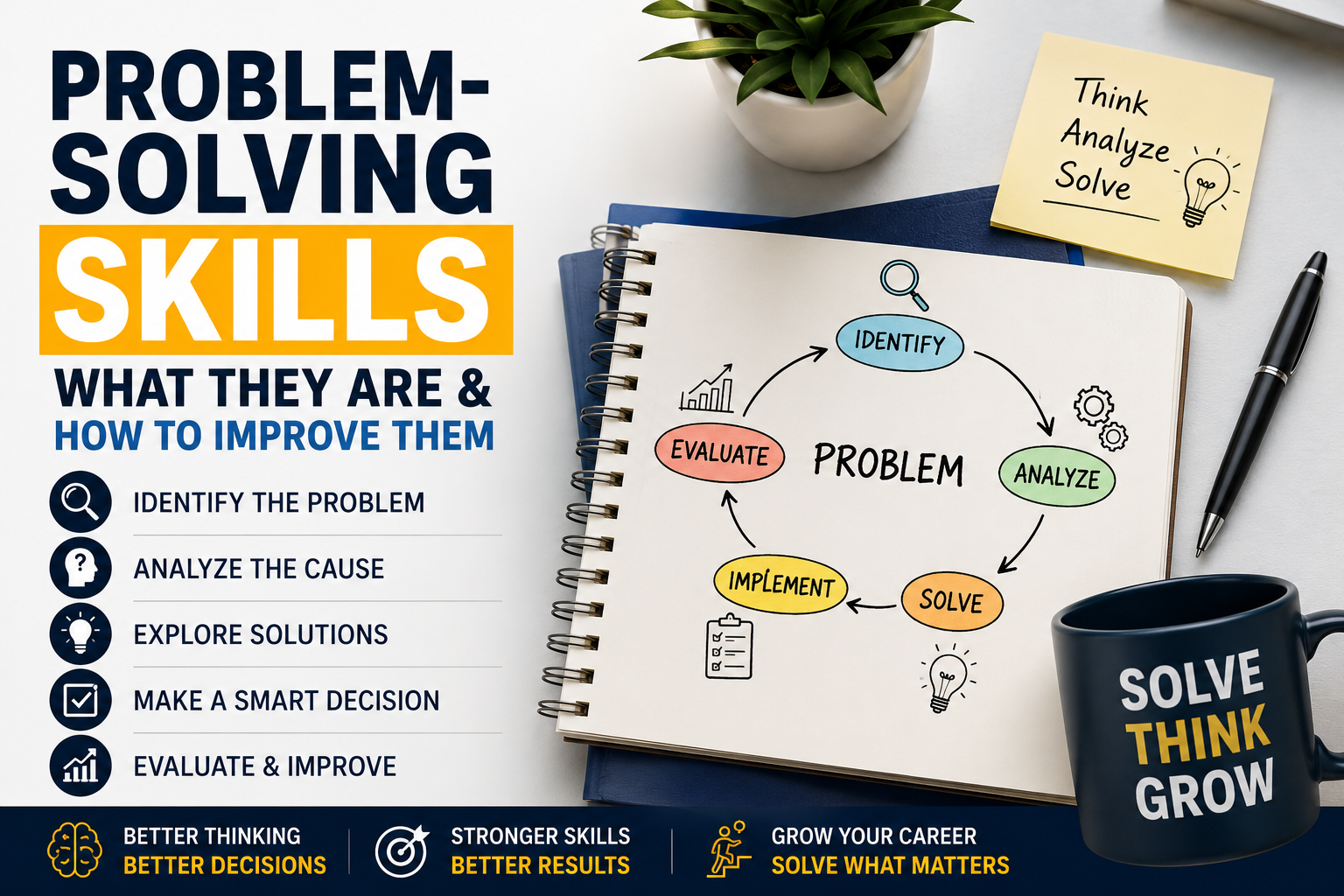
The Problem-Solving Process
A structured approach can make difficult problems easier to manage.
Step 1: Define the Problem Clearly
Before solving a problem, make sure you understand what the problem actually is.
A vague statement such as:
“Our website isn’t working.”
is difficult to act on.
A clearer description might be:
“Customers using mobile devices receive an error when they try to submit the checkout form.”
Now you have something specific to investigate.
Ask:
- What exactly is happening?
- Who is affected?
- When did it start?
- How frequently does it happen?
- What should be happening instead?
A well-defined problem is much easier to solve.
Step 2: Gather Information
Next, collect relevant information.
Avoid making major decisions based only on assumptions.
Depending on the situation, you might review:
- Data
- Logs
- Customer complaints
- Reports
- Previous incidents
- Employee feedback
- Documentation
The goal isn’t to collect every piece of information available.
Focus on information that can help explain the problem.
Step 3: Identify the Root Cause
Solving symptoms isn’t always enough.
Imagine employees repeatedly miss project deadlines.
The obvious solution might be:
“Tell everyone to work faster.”
But the actual problem could be unclear responsibilities, unrealistic deadlines, missing resources, poor communication, or frequent changes in priorities.
Ask why the problem is happening.
Then keep investigating until you reach a cause that can actually be addressed.
Step 4: Generate Possible Solutions
Don’t automatically choose the first idea that comes to mind.
List several possible solutions.
For each option, consider:
- Advantages
- Disadvantages
- Cost
- Time required
- Difficulty
- Risks
- Expected results
For smaller problems, this process might take only a few minutes.
Complex problems may require research and discussion with other people.
Step 5: Choose the Best Practical Solution
The “best” solution isn’t always the most sophisticated one.
A good solution should fit the circumstances.
For example, completely replacing a software system might solve a minor technical problem, but a small configuration change could achieve the same result with far less cost and disruption.
Evaluate what is practical.
Step 6: Implement the Solution
A decision has little value until someone acts on it.
Determine:
- What needs to happen?
- Who is responsible?
- What resources are required?
- When should it be completed?
- How will progress be measured?
For larger problems, break implementation into smaller tasks.
Step 7: Evaluate the Result
Don’t assume the problem is solved simply because you’ve taken action.
Check the outcome.
Ask:
- Did the solution work?
- Is the original problem gone?
- Did the solution create another issue?
- What did we learn?
- Should anything be documented?
This final step helps turn one solved problem into knowledge that can be used again.
Problem-Solving Examples in the Workplace
Understanding the concept becomes easier when you see how it applies to real situations.
Customer Service Example
Problem: A customer is upset because an order arrived late.
A strong response might involve:
- Listening to the customer’s concern.
- Reviewing the order history.
- Identifying the cause of the delay.
- Explaining available options.
- Providing an appropriate resolution.
- Recording the issue if it reveals a recurring delivery problem.
The employee isn’t simply apologizing. They’re investigating and resolving the situation.
Marketing Example
Problem: A marketing campaign generates traffic but very few sales.
The team might examine:
- Traffic sources
- Landing-page performance
- Audience targeting
- Pricing
- Page speed
- Checkout behavior
Instead of assuming the advertising failed, they investigate where potential customers are leaving the process.
IT Example
Problem: Employees cannot access an internal application.
A technician may:
- Confirm who is affected.
- Reproduce the issue.
- Check network connectivity.
- Review server status.
- Examine recent changes.
- Test a potential fix.
- Verify access has been restored.
This demonstrates structured troubleshooting.
Project Management Example
Problem: A project is falling behind schedule.
The project manager might identify delayed tasks, determine which tasks affect the final deadline, redistribute resources, adjust priorities, and communicate the revised plan to stakeholders.
Remote Work Example
Problem: Team members in different time zones keep missing important updates.
Possible solutions could include improving documentation, establishing communication expectations, creating asynchronous status updates, or changing how meetings and decisions are recorded.
Remote employees often need particularly strong problem-solving abilities because immediate in-person assistance may not be available.
How to Improve Your Problem-Solving Skills
Like most professional skills, problem solving improves through deliberate practice.
Ask Better Questions
Instead of immediately asking:
“How do I fix this?”
start with:
“What exactly is happening?”
Then ask:
- When did it begin?
- What changed?
- Who is affected?
- What evidence do I have?
- What am I assuming?
- Has this happened before?
Better questions often produce better solutions.
Separate Facts From Assumptions
Suppose a coworker hasn’t responded to your message.
Fact: You haven’t received a response.
Assumption: They’re ignoring you.
There could be many other explanations.
Learning to separate what you know from what you believe can prevent poor decisions.
Break Large Problems Into Smaller Parts
A problem such as:
“I can’t find a job.”
is extremely broad.
Break it down:
- Am I applying for suitable positions?
- Is my resume getting through ATS screening?
- Am I receiving interviews?
- Am I reaching the final interview stage?
- Do my skills match the jobs I’m targeting?
Each smaller problem suggests a different solution.
This technique works in both career planning and the workplace.
Look for Root Causes
Don’t stop at the first explanation.
If something goes wrong repeatedly, ask why.
For example:
Problem: Reports are consistently late.
Why?
Because employees submit information late.
Why?
Because they receive reminders too late.
Why?
Because the process depends on someone manually sending reminders.
Now the team has identified a process issue that may be improved through automation or scheduling.
Consider More Than One Solution
Challenge yourself to generate at least three possible solutions before deciding.
This prevents you from becoming attached to the first idea.
Even if you ultimately choose your original solution, comparing alternatives can help confirm that it’s reasonable.
Think About Consequences
Before implementing a solution, ask:
- What happens if this works?
- What happens if it fails?
- Who else will be affected?
- What does it cost?
- Can the decision be reversed?
Thinking one step ahead can prevent a quick fix from becoming a bigger problem.
Learn From Past Problems
After resolving an important issue, review what happened.
Consider keeping notes about:
- The original problem
- Root cause
- Solution
- Result
- Lessons learned
Over time, you’ll build your own library of experience.
Practice With Real Projects
Courses can teach problem-solving frameworks, but real experience is particularly valuable.
Personal projects, internships, volunteering, freelance work, and workplace responsibilities all give you opportunities to solve actual problems.
Don’t only focus on whether the project succeeds.
Pay attention to how you respond when something goes wrong.
How to Demonstrate Problem-Solving Skills on a Resume
Simply adding “problem-solving skills” to your skills section isn’t very convincing.
Show evidence.
Instead of:
Good problem-solving skills.
write an accomplishment that demonstrates them.
For example:
Identified a recurring customer support issue and created a troubleshooting guide that reduced repeat inquiries.
Or:
Analyzed website performance problems and implemented optimizations that improved page loading times.
A strong resume shows the problem, action, and result.
Whenever possible, quantify the outcome.
For example:
Redesigned an inventory tracking process that reduced weekly reporting time by 30%.
Specific evidence is more powerful than simply claiming to possess a skill.
How to Talk About Problem Solving in an Interview
Employers often assess problem-solving ability through behavioral interview questions.
You might be asked:
- Tell me about a difficult problem you solved.
- Describe a time something didn’t go according to plan.
- Tell me about a time you had to make a difficult decision.
- How do you approach unfamiliar problems?
- Describe a situation where your first solution didn’t work.
- Tell me about a time you improved a process.
A useful way to structure your answer is the STAR method:
Situation
Briefly explain the context.
Task
Describe what you needed to accomplish.
Action
Explain specifically what you did.
Result
Describe what happened because of your actions.
Focus most of your answer on the Action section because that’s where the interviewer can see your problem-solving process.
Problem-Solving Skills for Freshers
You don’t need years of professional experience to demonstrate problem solving.
Freshers can use examples from:
- College projects
- Group assignments
- Internships
- Volunteer work
- Competitions
- Personal projects
- Part-time jobs
- Student organizations
For example, perhaps your college project stopped working shortly before the deadline.
Explain how you diagnosed the problem, divided responsibilities among team members, tested possible fixes, and completed the project.
The situation doesn’t need to involve a large company.
Employers are interested in how you think and respond.
Problem Solving and Critical Thinking: What’s the Difference?
Problem solving and critical thinking are closely related but aren’t exactly the same.
Critical thinking is the ability to evaluate information, question assumptions, and form reasoned judgments.
Problem solving uses those abilities to move from identifying a problem toward finding and implementing a solution.
You can think of critical thinking as one of the tools inside the larger problem-solving process.
Developing your critical thinking skills can therefore make you a stronger problem solver.
Can You Learn Problem-Solving Skills?
Yes.
Some people may naturally enjoy puzzles, analysis, or troubleshooting, but professional problem solving isn’t a fixed personality trait.
You can improve by:
- Working on unfamiliar problems
- Asking better questions
- Practicing critical thinking
- Learning from mistakes
- Seeking feedback
- Studying how experienced colleagues approach problems
- Taking responsibility for projects
- Reviewing decisions after outcomes are known
The goal isn’t to reach a point where you never make a wrong decision.
That’s unrealistic.
The goal is to develop a repeatable process that helps you make better decisions with the information available.
Common Problem-Solving Mistakes
Acting Before Understanding the Problem
Moving quickly isn’t useful if you’re solving the wrong problem.
Relying on Assumptions
Look for evidence before reaching conclusions.
Choosing the First Solution
Consider alternatives before committing.
Ignoring Other Perspectives
Someone closer to the problem may have information you don’t.
Focusing Only on Symptoms
Recurring problems often require addressing the underlying cause.
Refusing to Change Course
If evidence shows that your solution isn’t working, adjust it.
Failing to Review the Outcome
Without evaluation, you may never know whether your solution actually worked.
Frequently Asked Questions
What are problem-solving skills?
Problem-solving skills are abilities that help you identify problems, understand their causes, evaluate possible solutions, make decisions, and implement appropriate actions.
What are examples of problem-solving skills?
Examples include critical thinking, analytical thinking, research, creativity, decision-making, communication, collaboration, adaptability, and attention to detail.
Why do employers value problem-solving skills?
Employers need people who can respond effectively when challenges arise. Strong problem solvers can help improve processes, resolve customer issues, reduce mistakes, make better decisions, and adapt to changing situations.
How can I improve my problem-solving skills?
Practice defining problems clearly, gathering evidence, questioning assumptions, identifying root causes, comparing several solutions, evaluating consequences, and reviewing the results of your decisions.
How do I show problem-solving skills on my resume?
Use accomplishments rather than simply listing the skill. Describe a specific problem you identified, the action you took, and the result you achieved.
How do I demonstrate problem-solving skills with no work experience?
Use examples from academic projects, internships, volunteering, personal projects, competitions, part-time work, or student activities. Focus on the challenge, your approach, and the result.
Final Thoughts
Strong problem-solving skills can make you more effective in almost any career.
Being a good problem solver doesn’t mean having an immediate answer whenever something goes wrong. It means knowing how to slow down, define the problem, gather useful information, identify possible causes, evaluate solutions, and take appropriate action.
Start with small situations.
Ask better questions. Challenge your assumptions. Consider more than one solution. Pay attention to what happens after you make a decision.
Most importantly, learn from both successful and unsuccessful outcomes.
Over time, this approach can help you become someone colleagues and employers trust when a situation is unclear, difficult, or unexpected—and that’s a valuable professional skill in almost any workplace.