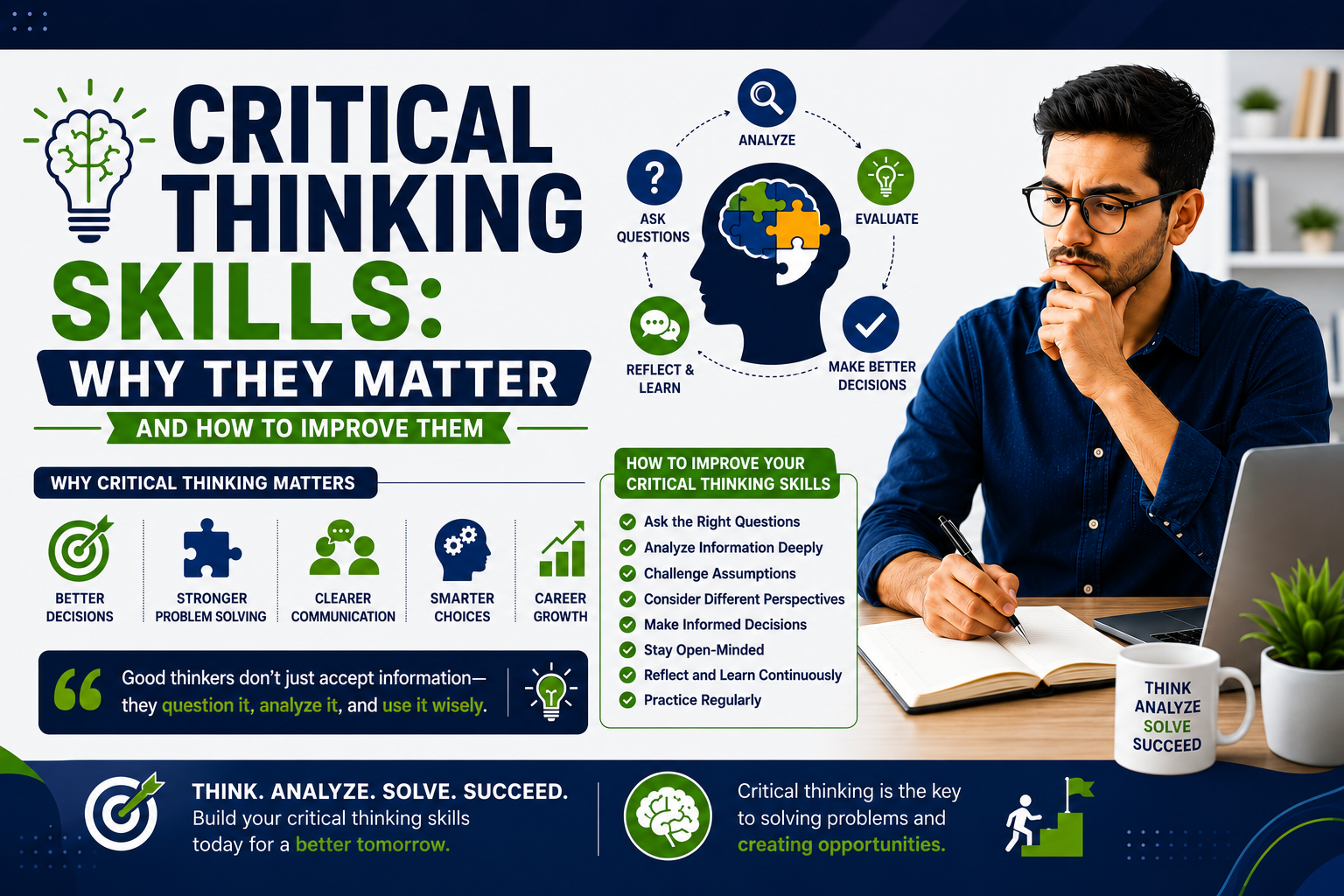
Critical Thinking Skills: What They Are and How to Improve Them
Have you ever made a quick decision and later realized it wasn’t the best choice?
Stay connected
Add us as a trusted source on Google
Get our latest guides, updates, and helpful resources surfaced more often when you search and browse.
Maybe you bought something you didn’t need, believed information without checking the facts, or solved a problem only to discover it came back later.
This is where critical thinking skills become valuable.
Critical thinking helps you analyze situations, ask the right questions, and make better decisions based on facts instead of assumptions. Whether you’re a student, job seeker, business owner, or working professional, developing this skill can improve both your career and everyday life.
In this guide, you’ll learn what critical thinking skills are, why employers value them, and practical ways to strengthen them.
What Are Critical Thinking Skills?
Critical thinking is the ability to think carefully before making a decision. It involves gathering information, analyzing facts, considering different options, and choosing the most effective solution.
Instead of reacting immediately, critical thinkers take a step back and ask questions.
Example
Imagine you’re buying a laptop for work.
Instead of purchasing the cheapest option, you compare specifications, read customer reviews, check warranty details, and consider your long-term needs before making a decision.
That’s an example of critical thinking.
Why Are Critical Thinking Skills Important?
Every day we make decisions that affect our work, finances, education, and relationships.
Good critical thinking helps you:
- Solve problems more effectively
- Make smarter decisions
- Avoid costly mistakes
- Adapt to new situations
- Work better with others
Because of these benefits, employers consider critical thinking one of the most valuable workplace skills.
Workplace Example
Your manager asks why a project is behind schedule.
Instead of blaming a teammate, you review the workflow and discover that unclear requirements caused delays. You suggest improving project documentation for future assignments.
Rather than simply identifying the problem, you also provide a practical solution.
Key Characteristics of Critical Thinkers
People with strong critical thinking skills usually share several common habits.
They Ask Questions
Instead of accepting information immediately, they look for evidence.
Example
Instead of believing a social media post, they verify the information by checking trusted news websites and official sources.
They Stay Open-Minded
They are willing to change their opinion if new evidence supports a better conclusion.
Example
A business owner believes newspaper advertising is generating customers.
After reviewing marketing reports, they discover social media campaigns bring more sales and decide to shift their advertising budget.
They Think Before Acting
Good decision-makers don’t rush.
They consider the possible outcomes before taking action.
Example
Before replying to an unhappy customer, a support representative reviews the customer’s history and investigates the issue. This helps provide a better solution and avoids unnecessary conflict.
Practical Ways to Improve Critical Thinking Skills
Critical thinking improves with practice.
Here are several simple ways to develop this skill.
1. Ask Better Questions
Whenever you’re faced with a decision, ask yourself:
- Why is this happening?
- What evidence supports this?
- Are there other possible solutions?
- What could happen if I choose a different option?
Example
You’re thinking about changing jobs.
Instead of focusing only on salary, compare company culture, career growth, work-life balance, and long-term opportunities.
2. Break Problems Into Smaller Parts
Large problems often seem overwhelming.
Breaking them into smaller tasks makes them easier to solve.
Example
Instead of saying,
“I need to build a business website.”
Break it into:
- Register a domain
- Purchase hosting
- Install WordPress
- Design the homepage
- Add services
- Publish content
Small steps make progress much easier.
3. Learn From Your Mistakes
Mistakes provide valuable lessons.
After solving a problem, think about:
- What went well?
- What could be improved?
- What would I do differently next time?
Example
You missed an important project deadline because you underestimated the amount of work.
For your next project, you create a weekly schedule and set earlier internal deadlines.
4. Read From Multiple Sources
Different sources provide different perspectives.
Reading only one opinion can lead to poor decisions.
Example
If you’re researching remote jobs, compare company websites, career blogs, employee reviews, and industry reports before making a decision.
5. Practice Solving Real Problems
The best way to improve critical thinking is by solving practical challenges.
Ideas include:
- Managing a monthly budget
- Organizing an event
- Building a personal website
- Planning a vacation
- Learning a new software application
Example
Your website becomes slow.
Instead of immediately changing your hosting provider, you test plugins, optimize images, and check server performance to identify the actual cause.
Common Mistakes That Prevent Critical Thinking
Believing Information Without Verification
Not everything you read online is accurate.
Always verify important information before acting on it.
Making Emotional Decisions
Emotions are important, but decisions should also be supported by facts.
Example
Buying an expensive course because everyone else recommends it may not be the best choice if it doesn’t match your career goals.
Ignoring Other Opinions
Different perspectives often reveal solutions you may not have considered.
Listening doesn’t mean agreeing—it means gathering more information.
How Employers Evaluate Critical Thinking
Many interview questions are designed to assess critical thinking.
Examples include:
- Tell me about a difficult problem you solved.
- Describe a challenging decision you made.
- Tell me about a time you improved a process.
- Explain how you handled an unexpected challenge.
Example Answer
Question: Tell me about a time you solved a problem.
Answer:
“Our company website became unusually slow after installing several plugins. I tested each plugin individually, identified the one causing the issue, replaced it with a lighter alternative, and reduced page loading time by more than 40%. This improved both customer experience and search engine performance.”
Notice how the answer explains the problem, the actions taken, and the measurable result.
How to Show Critical Thinking on Your Resume
Avoid writing:
Excellent critical thinking skills
Instead, demonstrate the skill through achievements.
Good examples include:
- Improved a business process that reduced completion time by 25%.
- Identified recurring customer issues and suggested a permanent solution.
- Optimized website performance by analyzing server logs and fixing bottlenecks.
- Introduced automation that reduced repetitive manual work.
Specific accomplishments are much stronger than general statements.
Final Thoughts
Critical thinking is one of the most valuable skills you can develop for your career and everyday life.
It helps you make informed decisions, solve problems efficiently, and adapt to changing situations with confidence.
The more you practice asking questions, analyzing information, and learning from experience, the stronger your critical thinking skills will become.
Remember, becoming a better thinker doesn’t happen overnight. It happens through consistent practice and a willingness to keep learning.
Frequently Asked Questions (FAQs)
What are critical thinking skills?
Critical thinking skills are the ability to analyze information, evaluate evidence, and make logical decisions instead of relying on assumptions or emotions.
Why are critical thinking skills important?
They help you solve problems, make better decisions, reduce mistakes, and perform more effectively at work and in everyday life.
Can critical thinking skills be learned?
Yes. Anyone can improve critical thinking by practicing problem-solving, asking better questions, evaluating information carefully, and learning from experience.
How do employers test critical thinking skills?
Employers often use behavioral interview questions, case studies, technical assessments, and real-world scenarios to evaluate how candidates think and solve problems.
What’s the difference between critical thinking and problem-solving?
Critical thinking focuses on analyzing information and choosing the best approach, while problem-solving involves putting that decision into action to resolve a specific issue.
How can students improve critical thinking skills?
Students can improve by participating in discussions, solving puzzles, reading different viewpoints, working on projects, and asking thoughtful questions during learning.
What careers require strong critical thinking skills?
Almost every profession benefits from critical thinking, including software development, healthcare, engineering, finance, education, marketing, law, customer service, and business management.
Can critical thinking improve career growth?
Yes. Professionals with strong critical thinking skills are often better at making decisions, solving workplace challenges, and adapting to change, making them valuable to employers.